Review of Ruger Flat Top Bisley 44 Special
Ruger'southward trim and handsome .44 Special Flattop Blackhawk is a most ideal combination of ability and packability for the trail.
Nothing in the firearms world is more than consistent than change and information technology is an interesting procedure to lookout man. Markets and manufacturing methods change, needs and tastes modify, one-time favorites disappear and new favorites emerge. Modify may not mean a positive 1 nor that new is better. But every now and then, something comes along that transcends the usual guerilla-marketing tactics.
Ruger teamed up with their largest distributor, Lipsey's, to answer the long-running prayers of legions of die-hard .44 Specialites for a .44 Blackhawk that does non say magnum anywhere on it—the long overdue .44 Special Blackhawk is finally here.
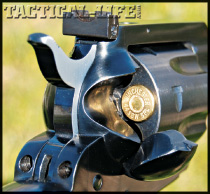 Introduced around 1907 as an outgrowth of the older .44 Smith & Wesson Russian to provide more powder capacity, the .44 Special achieved a dedicated post-obit beginning in the early days of smokeless powder big-bore handgun calibers that continued on in the hands of such notables every bit Elmer Keith and Skeeter Skelton. Skelton after wrote that he was so addicted of the quotient that later on WWII he sold his .38 Special and his saddle, quit smoking, cashed in his state of war bonds, bought a clean .38-40 Colt Peacemaker for $125 and sent it to the Christy Gun Works to be converted to .44 Special.
He then had Rex'southward Gunsight Company fit it with an adaptable rear and mirrored beaded ramp front sight, got a trigger job and a re-blue washed elsewhere and added for a whopping $twenty a one-piece ivory grip. While admitting that the round-nosed atomic number 82 manufacturing plant load running a 246-grain bullet at about 760 feet per second (fps) was "on par" with the .38 Special in effectiveness, he experimented with handloads in his Colt, eventually deciding that a 250-grain bullet loaded upward to 1200 fps left the .357 Mag in the dust, and concluded that a cast-lead Keith semi-wadcutter dropped from a Lyman #429421 mould in front of 17.v grains of 2400 powder and a CCI magnum primer would make a ameliorate manstopper than a .30-xxx rifle. (Today, this load and a similar one also used past Keith would not be recommended in a .44 Special with the new and slightly hotter 2400 pulverisation.) Skelton settled on seven.5 grains of Unique with a 250-grain Keith bullet every bit his working load. Incidentally, at the fourth dimension of his expiry in 1988, he commissioned a Ruger Old Model Flattop Blackhawk conversion from .357 Magazine to .44 Special. He felt information technology was a trim and reliable belt gun and a package worthy of the cartridge.
As anybody who can lay legitimate claim to being an old-timer in the revolver earth knows, Keith felt too confined by the limitations of the Filly SA (single-activeness) in his large-bore endeavors. In 1927 he abandoned the .45 Colt and switched to the .44 Special large-framed, double-action S&Westward platform for his research that grew the .44 Special into the .44 Mag. Writing in 1936, Keith considered the .44 Special "our finest big-caliber revolver by a wide margin." His preference for a powerful .44 continued on through into the .44 Rem Mag introduced in 1955.
Over the years, the .357 Magazine and .44 Mag take come to largely overshadow the erstwhile .44 Special, and a number of unlike revolvers accept been introduced and dropped from production. There was nothing special almost the early manufactory loads, and the caliber traditionally had to be handloaded to make it earn its name. Commercial ammunition has caught up to a degree in terms of more modernistic bullet types and more realistic operation among some specialty makers, just it is not commonly stocked on gun shop shelves. The .44 Special has a dedicated fan base just it is not a mainstream number.
Although relatively small, there remains a market for a quality-made .44 Special revolver. Lipsey's product development manager Jason Cloessner gambled on that market. Lipsey'southward often contracts with the maker for depression-number special runs of exclusives in variations that Ruger does not routinely catalog. When the mid-frame .357 Flattop Commemorative Blackhawk came out in 2005, along with updated production processes at the plant, it opened the door and it was not long before talks began virtually the possibility of a flattop in .44 Special.
It has e'er been possible to shoot Specials in any of the .44 Mag Blackhawks, just those are sizable pistols and the smaller frame makes for a more meaty combination of ability and weight. Production began in early 2009 with plans of 1,000 each of two-barrel lengths of 4.63 and v.5 inches.
Gun Details
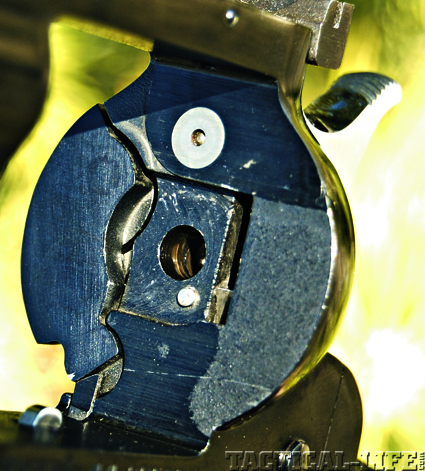 Recent contrary indexing pawl profoundly speeds up loading and unloading of the Flattop.

First off, you can await quality. As a longtime carrier, both professionally and privately, I have a fondness for shorter tubes on working sixguns so the 4.63-inch barrel was requested. Ruger has never offered a high level of shine on blued Blackhawks, but this one has a uniform, deep and dark finish that sets it off nicely. The trigger and hammer side flats are left in the white, as usual. The pistol wears the black-checkered polymer grip panels that are at present standard on most Ruger SAs since their longtime supplier of wood grips, Lett, closed up shop.
The fit between grip and main frame is very well done, partly due to the debate whether to use regular blend grip frames and ejector housings, or to go all steel. Running at 70/30, steel won out, and steel grip frames are always fitted to the primary frames whereas the alloy grip frames are not. This adds some poundage, which can be good or bad depending on your viewpoint. Aluminum totes lighter, steel reduces recoil in heavy loads. The actress weight is desired here.
Using the aforementioned frame and grip size every bit the New Vaquero, the .44 Special Flattop besides shares the internal key lock and the same gratuitous-spin pawl lockup that aligns each chamber in position for loading easily in the frame's gate cutout. But sights are a reversion to the older all-steel, fully adjustable Ruger Micro rear with its base fully inset into the flat topstrap. Regular alloy Blackhawk adaptable sights are fairly rugged, but steel is never a bad thing to have on a hardworking Ruger's sights.
There are two other points of interest on the .44 Special Flattop. As on all recent Ruger SAs the infamous warning is at present on the bottom of the barrel side by side to the ejector rod housing where it is generally out of sight and mind. Also, the cylinder base pivot does not take the long-running flanged head with a crescent cutout that has to be aligned with the butt when sliding it out or in to remove or supersede the cylinder for cleaning.
The barrel alert bothers some more than others and may not be an issue for you lot, but the Filly-style cylinder pin is much handier than the older Ruger type. It can be removed entirely without also dismounting the ejector housing, unlike other short-barreled Ruger SAs.
Range Fourth dimension
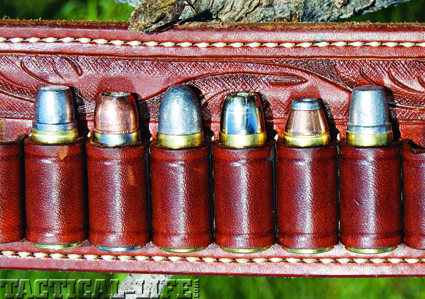 Left to right: Black Hills 250gr Keith SWC, Buffalo Bore 185gr. JHP, Winchester 200gr Silvertip HP, Winchester 246gr RNL, Speer 200gr Gilt Dot JHP, and Buffalo Diameter 255gr Keith SWC. For not-reloaders, the Buffalo Bores are an excellent pick in difficult-hitting commercial loads.
Handloading the .44 Special isn't an option right now, so acquisition of five current manufactory loads ran from slow to wow for a trip to the gravel pit. To comprehend the spectrum, the classic Winchester 246-grain RNL was tested first, then their 200-grain Silvertip JHP, Speer's 200-grain Gold Dot JHP, Buffalo Bore'due south 185-grain JHP and 255-grain Keith LSWC. Last was a stash of Black Hills' special run of 250-grain Keith LSWC loads that was offered for a short fourth dimension back when S&Due west introduced their .44 Special Thunder Ranch Model.
Every bit expected, the pedestrian 246-grain round nose was a pussycat in the 42.5-ounce Blackhawk, and the Buffalo Bore loads were both markedly stouter. Accuracy was about on par with my Ruger 50th Anniversary .44 Magazine, which is largely what induced me to purchase it and to buy this .44 Special when testing was over. The Ruger was controllable, and most empty contumely dropped correct out without using the rod.
The all-steel nature of this Flattop gives it a solid feel in the mitt and helps mitigate recoil of heavier loads. Well balanced, it is still a SA and some noticeable muzzle ascent will occur every bit it rolls back. But with these loads it was far less than a comparably barreled .44 Mag or hot-loaded .45 Colt. Trigger pull was a slightly creepy 4.75 pounds and the hammer was not oversprung equally Ruger SAs tended to be for several years. Loading is easier with the reversing alphabetize pawl than with older models with fewer tendencies to over-rotate past the gate aqueduct.
The archetype 246-grain lead was very tolerable as an occasional foray into nostalgia, for more serious uses the Winchester and Speer HPs provided mid-level functioning along with mid-level recoil. The 2 specialty loads step things upward another notch at both ends of the butt.
I complaint I have across the board in the current big-bore Ruger pollex busters that employ the checkered polymer grip panels is that they are sturdy simply the checkering on those things can bite with loads that produce big-fourth dimension recoil. The .44 Flattop was tolerable up to and including the Buffalo Bores, but I adopt a smooth grip. Ruger carries rosewood panels with the older blackness eagle logo medallions to fit the Blackhawk'due south smaller grip frame for $44. If you plan to exist using this .44 equally your main mammoth medicine, they would be a skilful investment.



Source: https://www.tactical-life.com/combat-handguns/rugers-new-model-44-special/
0 Response to "Review of Ruger Flat Top Bisley 44 Special"
Post a Comment