Netsparker Failed to Load Page Try Again
I will not run spider web security analysers without first understanding web security.
I volition not run spider web security analysers without get-go agreement web security.
I will not run web security analysers without first understanding web security.
Are we clear now? Skilful, because equally not bad as tools similar I'thousand nigh to discuss are, aught adept comes from putting them in the easily of people who can't properly interpret the results and grasp the concepts of what dynamic analysis scanners can and cannot cover. If you lot're looking for a tool to exercise all the hard work for you without really understanding what's going on, this isn't the post you lot desire to read! (Yes, at that place are places that sell "security in a box", no, practice non trust them!)
That said, Netsparker is rather awesome at automating the oft laborious procedure which is trawling through a website and looking for risks. I practice this all the time and it quickly becomes both repetitive and fourth dimension consuming. But it besides very often bears fruit, in fact this is why I wrote the Pluralsight class titled Hack Yourself First: How to become on the Cyber-Offense. The whole premise of this course is about how to identify insecure patterns in spider web apps, how to exploit those patterns and so near importantly, how the secure patterns await and how they defend against attacks. If I'm honest, it'south my favourite grade to date and I reckon it's a "must watch" for all spider web developers, although I will acknowledge some bias :)
Speaking of Hack Yourself Start, have you lot seen this train-wreck of a website?
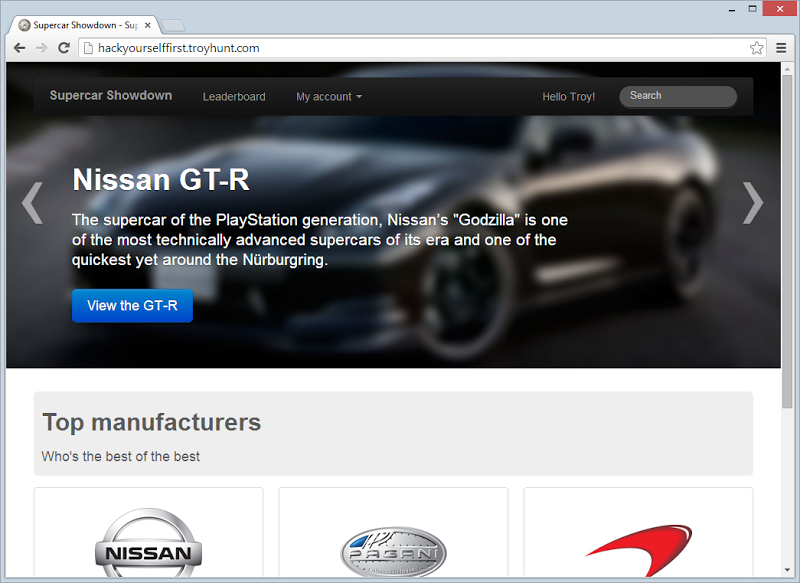
This is the site I built specifically for the course and information technology'southward publicly accessible at hackyourselffirst.troyhunt.com. It also has nearly fifty serious security vulnerabilities in it. These are the sorts of vulnerabilities I've seen over many, many reviews of web security over the years and I've built them all into the one mother of an insecure site. It's the kind of site that Netsparker should have a field solar day with then let's run across what it finds shall we?
Near Netsparker (and how to get it)
First things start: Netsparker has kindly given me a license for their Professional version and that'south enabled me to write this post. I'one thousand ofttimes asked about dynamic analysis tools and I wanted to have the material hither on my blog to explain what they practice and don't do and so that I could have a canonical resource on the topic. That said, I've long been an abet of Netsparker without incentivisation simply because I believe it'south the easiest on-demand, do information technology yourself dynamic security analysis tool for the audience I speak to. tl;dr – I'yard writing this considering it'due south a slap-up production and I desire to.
I've used the term "dynamic analysis" a few times now so let me quickly quantify that. When we talk nigh analysing source code (i.due east. y'all're inspecting the C# code of a .NET application), that'southward static analysis in that y'all're inspecting lawmaking that's lying dormant – it's non actually executing when the analysis is washed. When you take access to the source via static analysis, you lot'll pick up everything from poor variable naming to unused methods to actual serious security risks like how credentials are stored. In dynamic analysis, the lawmaking is actually running when information technology's tested and in a example like Netsparker (and many other security tools), you're remotely testing the code in that you're hitting a website over HTTP. This has some drawbacks insofar as a agglomeration of bad internal lawmaking practices can't exist identified (not unless they surface themselves via the website), but it too has its strengths, primarily that it'south easy to run dynamic analysis on the spot against any website. Information technology'southward also a much more accurate representation of the level of access an attacker has to a website and the underlying webserver infrastructure.
Moving on, yous can catch the software from netsparker.com and in that location's even a costless Community Edition to become yous started if you don't desire to pay money right away (at that place'due south also a demo edition they can claw you upward with and run against their test site). Naturally y'all become some limitations with this edition so check out the comparison chart if yous want to know what's in and what'due south out. The guys at Netsparker have too offered to support readers here with a fully functional trial of the whole matter so read the very lesser of this post for more info.
Cost wise, "Community" is free, "Standard" is $ane.95k/y simply is limited to iii websites and "Professional" is $v.95k/y but yous tin can go nuts on as many sites as you like. Standard and Pro have the same feature set so if yous're primarily interested in a unmarried site or 3, you lot can get all the bells and whistles for under $2k. All the prices come down a lot if you commit to a few years which is pretty typical for most services these days. I'll come up back to costs a little subsequently because it'due south important to understand them in the context of what the product is delivering. For now, permit'southward get on with actually using the thing.
Running the scan
Ane of the reasons why I've ever espoused the virtues of Netsparker is that information technology's just so damn like shooting fish in a barrel to go started with. Information technology can be every bit simple as entering the URL and then only letting the browse run:
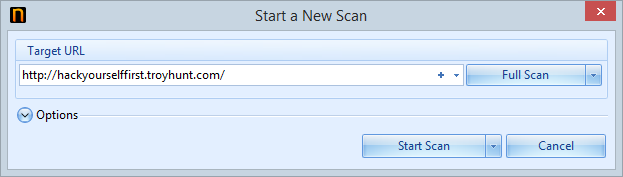
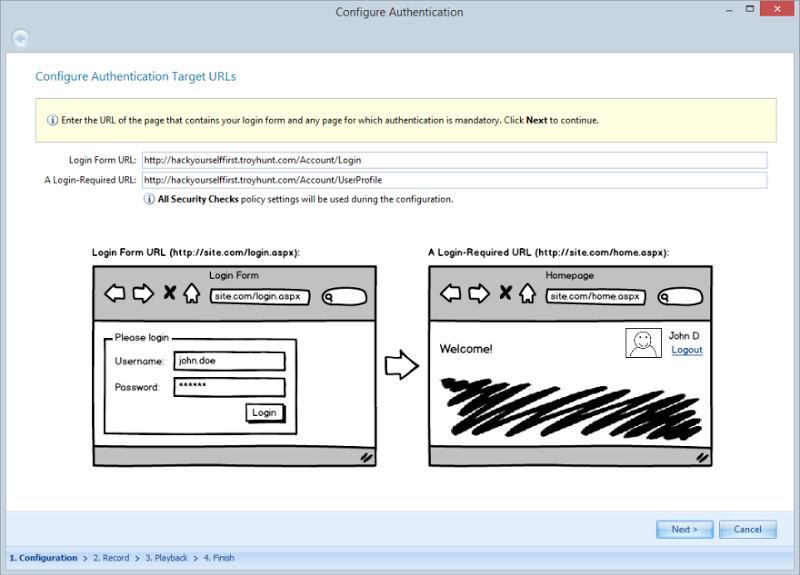
That works only fine for a public website that'due south anonymously accessible, merely this ane provides a facility for users to authenticate and then perform deportment under an identity. I desire to get a good idea of the security contour of services which require authorization as well so I've hit the little arrow next to "Beginning Scan" and elected to configure forms auth. What that means is that I at present need to define where the login form is and likewise provide a URL that shouldn't be accessible via bearding users:
One time I practise that, the login class is rendered in an inbuilt browser window and I tin provide credentials that enable me to authenticate:
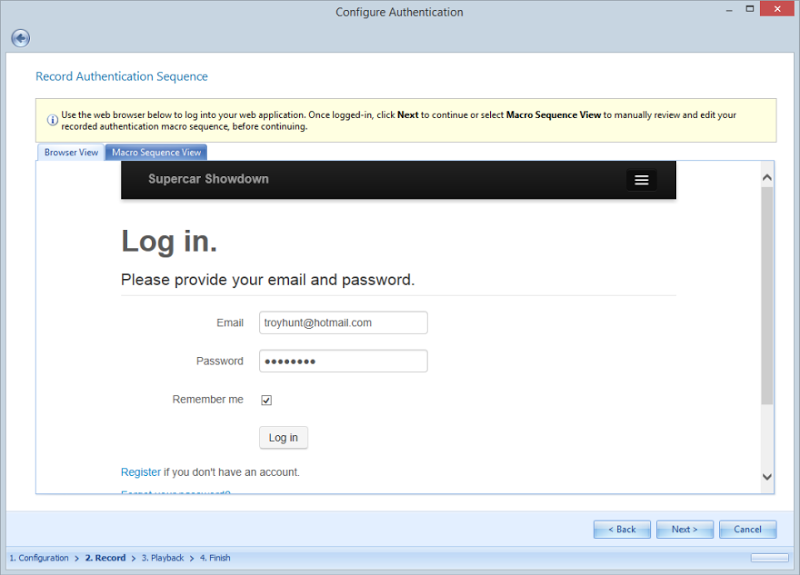
This is Netsparker essentially recording a macro of the process so that information technology can be repeated again during the scan process. Just to confirm the login process was correctly record and the macro successful, Netsparker at present shows a logged in view and a logged out view:
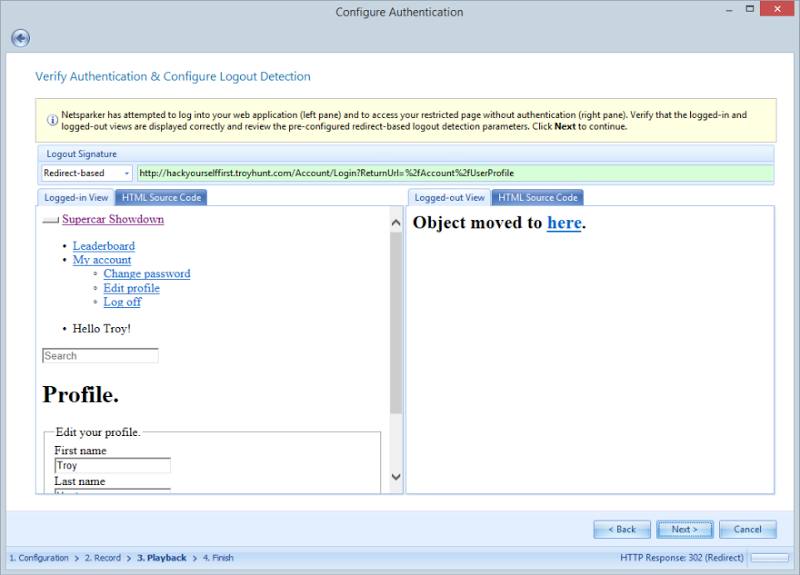
We're seeing "Object moved" on the logged out view as an attempt to access the contour page whilst not authenticated causes a 302 redirect to the login page.
That'due south the terminate of that, nosotros tin now kick the scan off and allow information technology go nuts. Only just before we practice…
Accept a wait at just how much stuff is configurable in a browse and the latitude of assault patterns it covers:
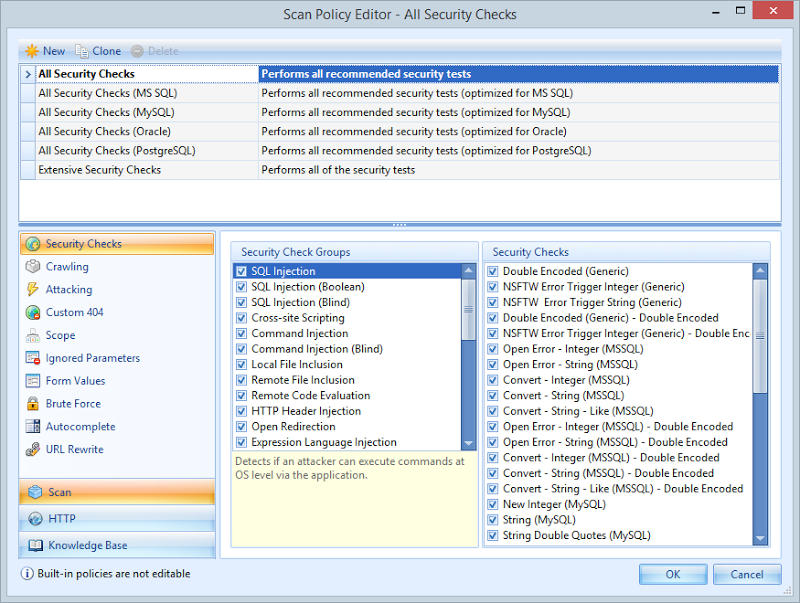
I won't become through these in detail (catch a demo version for that), simply I will point out that you can tailor the security checks based on the database back end which then has an impact on the SQL injection tests. Many of the assail vectors are tailored to the DB back stop then there's no point, for example, throwing specific attacks designed but for Oracle at a organization you know to be running SQL Server. That can patently have an impact on the duration of the exam which can become quite lengthy on a large site.
Enough of that, let's run it!
Website behaviour during and after the scan
Predictably, things are going to get a little basics during the scan. This site is sitting on Microsoft Azure and then I can go some prissy monitoring stats directly out of the management portal while the scan runs and as you tin come across, we're all of a sudden getting a lot of IO and a lot of errors:
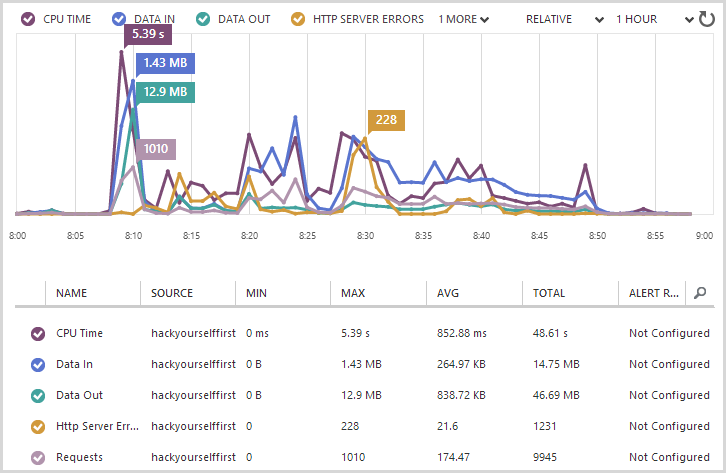
Errors are inevitable every bit many of the attempted attack vectors volition cause internal exceptions. For example, ASP.Cyberspace'southward request validation will usually burn down every bit soon as a cross site scripting attack is attempted. As well, many SQL injection attacks cause errors and indeed error-based SQL injection is ane of the most unremarkably used exploits against websites. The signal is that information technology makes it look like the wheels are coming off the website, the question is whether those errors are giving Netsparker any juicy info or not.
Browsing back over to the site, the starting time immediately apparent thing is that suddenly there are a heap of votes confronting some of the cars that weren't in that location earlier (Pagani started with three, McLaren with four and Koenigsegg with ii):

Well I can't contend with its penchant for the Pagani! I've shown this image to reinforce that information may exist manipulated as part of this process. It required an HTTP Postal service request in gild to submit all those votes and the tool happily made these. Do consider whether this is something y'all should really be running in your test surroundings instead (more on that soon).
Permit's have a wait at the Huayra and see what'south happened:
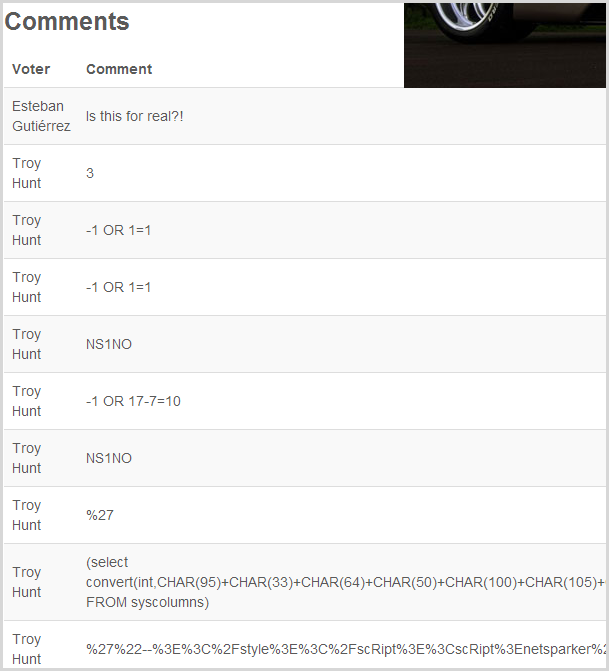
Ok, so here we have a heap of typical SQL injection pattern attacks and the listing goes on well beyond what I've shown here. (Incidentally, you're seeing my ID everywhere equally it was my credentials I used when I configured Netsparker to logon via forma auth earlier on.) The attack patterns are all the usual SQL injection suspects: uncomplicated boolean weather, attempts to forcefulness internal errors, obfuscation via graphic symbol encoding, timing attacks and and then on and so forth. I besides found the comments had attempts at exploiting local file inclusion vulnerabilities (trying to pull an internal file exterior the intended scope of the web app) and then clearly it'south not simply SQL injection beingness tested for via this detail vector.
Of class this raises one very of import point: be very careful about using tools similar this in a production environment. If you lot practice take a SQL injection vulnerability, you lot may well observe your data either in a terrible state of busted or nuked completely. (Incidentally, I'grand not saying that Netsparker will consciously issue delete commands or drop tables, simply that if y'all accept a serious SQLi chance like this then you lot'd want to work on the assumption that it will exist nuked!) You actually want to run this on a test surroundings first or at the very to the lowest degree, exist ready to restore product data if things get incorrect. Of course the other way of looking at information technology is that you lot should run these tools in production because if you're going to have a SQL injection vulnerability, it's better you detect it first in an ethical fashion rather than an attacker finding it and pastebining all your datas. And then over again, you may as well notice that even with no SQL injection risk the data is manipulated – what if the app correctly parameterises input and only passes it through to the underlying query which happens to exist an insert or an update? tl;dr – consider the pros and cons, sometimes i makes sense and the other doesn't.
And so that'due south the website covered, let'south move onto the results considering later on all, that'due south what we're really interested in here.
The browse summary
Getting dorsum to Netsparker itself, in one case the browse wraps up we get a nice GUI with the results. We've got a fully mapped out directory tree, stats on the scan (four requests a second and nearly 10k in total), and then some traffic lights and problems list:
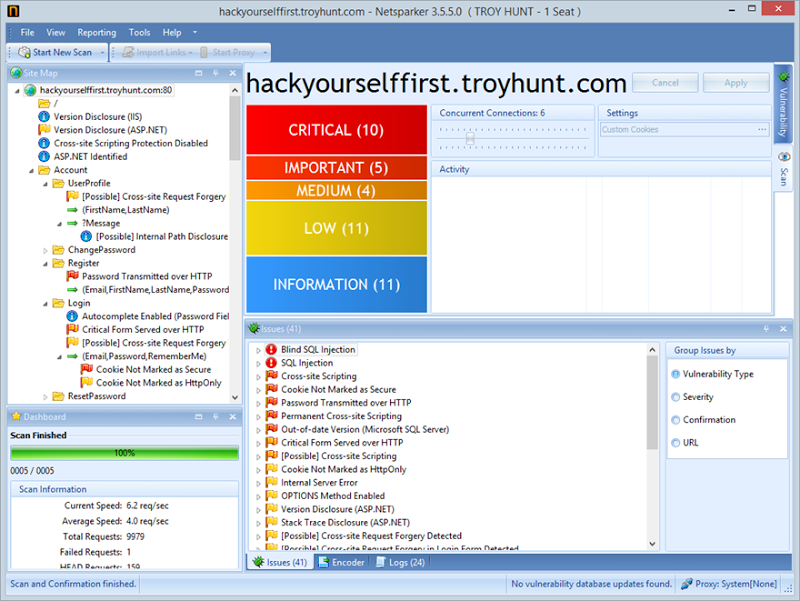
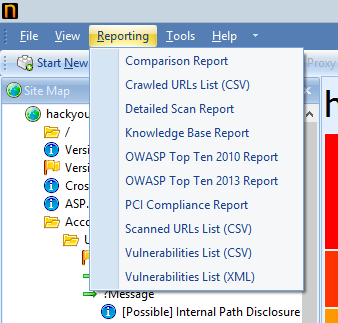
For people that would rather trawl through results themselves, I've exported the whole thing in PDF format which you lot tin download for yourself. At that place are a bunch of different report formats you can pump the data out to depending on how you want to use information technology:
Moving on, hazard classification is pretty common across this class of tool and inevitably your eye is going to go straight to the critical stuff. This particular scan has a expert spread of findings across the risk categorisation and then it's a skilful example to run with. Allow'south starting time delving into them and come across how adept a job it's washed of picking up vulns.
Critical findings
There were 10 disquisitional findings and they suspension downward similar this:
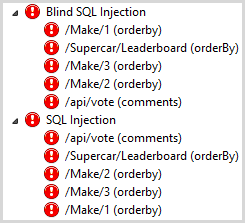
One of the first matter you'll discover is that there appears to exist some redundancy; according to the semantically formed URLs, 3 different "makes" (Nissan, McLaren, Pagani) are at risk of a blind SQL injection attack. Of course without fifty-fifty looking at the lawmaking we could safely assume that this is just a parameterised path and indeed makes 4 and 5 and 6 and and so on are all at risk of the same vulnerability. You lot tin see the aforementioned design under the SQL Injection node beneath that and whilst every bit a human it'south quite easy to determine that this is the 1 risk on multiple paths, it's harder for an automated script to brand that determination, particularly when the path may not be as obvious as an car-incrementing integer.
And therein lies one of the kickoff important lessons about these tools and why I had the very repetitive opening paragraph; the ease with which this report was generated was awesome, but without beingness able to properly translate the results you're inquire risk of drawing simulated conclusions. Of course information technology's more than just that also in that ultimately you want to ensure whoever it is that has a report like this state in their inbox with a "pleez fix" message needs to understand the risk and what to practice next. Indeed this is exactly why I created the OWASP Top x for .NET developers series, because I was seeing devs get these reports and accept absolutely no thought what to do with them! More on that later though, let'southward get back to those critical findings.
What I really similar nearly Netsparker is that when we drill into a finding like that beginning blind injection one, there's a slap-up caption that's very easily legible:
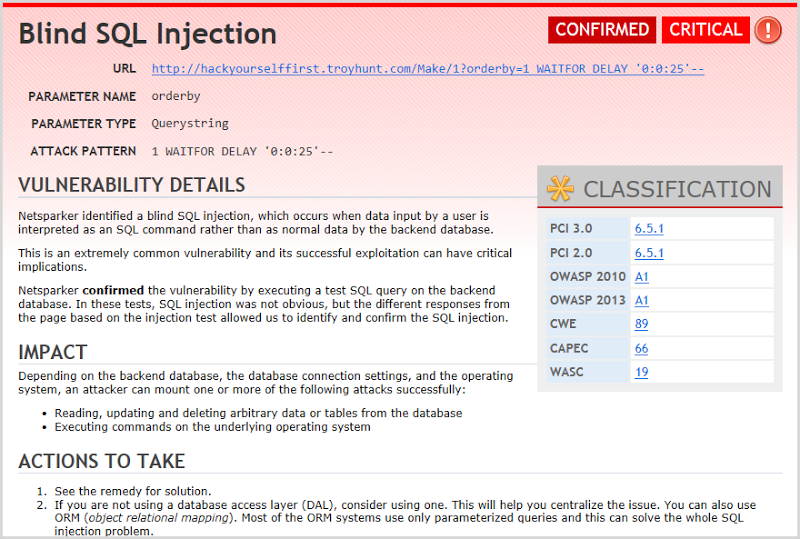
What this is saying is that by injecting a "WAITFOR Filibuster" SQL statement into the path, Netsparker was able to cause the database to execute this arbitrary piece of syntax thus validating that the app is at risk of a time-based injection assault. If why this matters is a foreign concept, check out my postal service on Everything you lot wanted to know about SQL injection (but were agape to ask). Netsparker is entirely correct – there is a bullheaded injection attack adventure – but information technology's besides the aforementioned resource with the aforementioned vulnerability that and so appears farther down the tree under the "SQL Injection" node. In short, out of those 10 critical risks, 6 of them are the 1 resource requiring the 1 slice of work. Once again, understanding how to interpret these reports is key.
Moving on though, there's heaps of info on what the vuln is, the impact, what to practise next then a whole bunch of stuff that scrolls off the screen including some very handy links to things like the OWASP SQL Injection folio. Speaking of OWASP, information technology also features in the classification table at mid-right so yous can drill downwardly exactly into how the OWASP Elevation 10 views this risk. If you're setting the Top ten every bit a set of security requirements for your apps (and you should exist), this is a skilful correlation.
I won't dwell much more on the injection risks other than to point out the one for the /api/vote path:
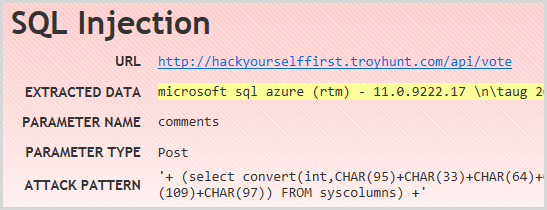
The reason this is pregnant is that Netsparker has actually found what is a client side async JavaScript telephone call using jQuery. Information technology's as well a POST asking and indeed this is the resource that populated the DB with all those votes we saw in the before screen grab. It's important equally it demonstrates that the tool is doing much more than just itch links, indeed it's determining how the app would behave in the browser and learning of potential attack vectors it should probe. In an increasingly async world, that'south pretty essential.
Important findings
Onto the next tier of criticality and here's what we're seeing:
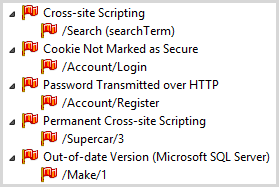
Most of these are discrete and we're actually seeing different vulnerabilities here without any doubling up. Let'south touch on each:
Firstly, yes, there's a reflected XSS risk on the search folio and Netsparker kindly provides this link to test it: http://hackyourselffirst.troyhunt.com/Search?searchTerm=%27%2Balert(9)%2B%27 – that'south your classic warning box XSS proof right there.
Next up is the insecure cookie and yep, I did (deliberately!) neglect to flag the cookie chosen "AuthCookie" as secure and then aye, it would be sent over an unencrypted connection which would be bad if you were worried most a man in the middle attack (and y'all should be when information technology's an auth cookie, refer to Firesheep if you're not sure why that'southward of import). Merely of course in that location are times where yous might legitimately want a cookie to not exist flagged as secure (i.e. simply persisting someone'due south name over both secure and insecure schemes) so you desire to sentinel out for false positives on that one. Let'due south be clear besides – that'south not a criticism of Netsparker – that finding could be either incorrect or correct depending on how the site has been implemented.
Passwords being submitted over HTTP on registration is both self-explanatory and nasty. It'south also very like shooting fish in a barrel to observe yourself so yes, it's nice to get the study stating it merely you can also just "eyeball" this ane.
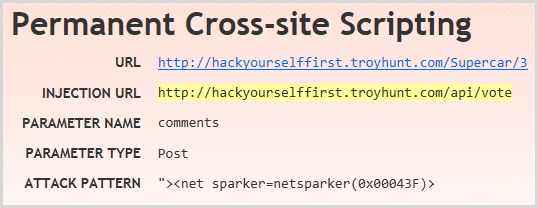
The permanent XSS finding (also oft referred to as "persistent" XSS) is a pretty nifty one because it requires a bit more orchestration. When XSS is persisted, it's actually in the data layer and then for example, information technology's saved when a class is submitted and then unlike reflected XSS which relies on someone clicking a malicious URL with the XSS payload, the persisted XSS is shown to everyone. It'south keen considering it requires the scanning tool to place an entry signal to salve the data then an leave point where it's rendered back to the screen. The former depends on missing validation at input and the latter depends on missing encoding on output. You can see both the URL with the XSS and the infection URL on the summary screen:
The final of import finding is an interesting one because depending on how you await at it, information technology could exist viewed as a false positive:
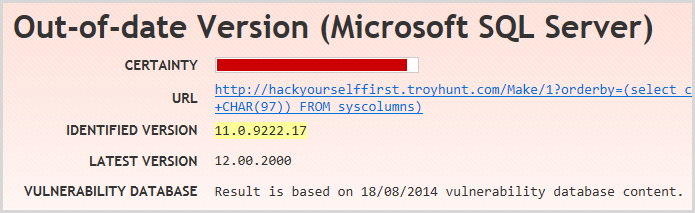
Yes, the current version of SQL Server is 12 (also known as SQL Server 2014) and yes, version 11 (AKA SQL Server 2012) has been superseded, but this is all running on SQL Azure which is a PaaS offer. Not just is it not full blown SQL Server as we know it (at that place are numerous small differences), y'all besides have no control over the version equally it's simply "SQL as a service". (Incidentally, I've provided the Netsparker guys with this feedback and they've taken it on board.) You lot could too debate that your DB being one gen behind current version is a whole different take a chance to, say, persistent XSS, but nosotros could also exist here all day disagreeing with people nearly the relative risks of various security findings!
Medium Findings
This one is a little interesting in terms of the second set of findings:
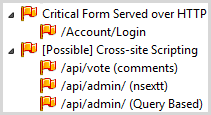
But we'll start with the first and it's spot on – the login form is loaded over HTTP. Netsparker very adeptly identifies and summarises exactly what I've been ranting on about for years:
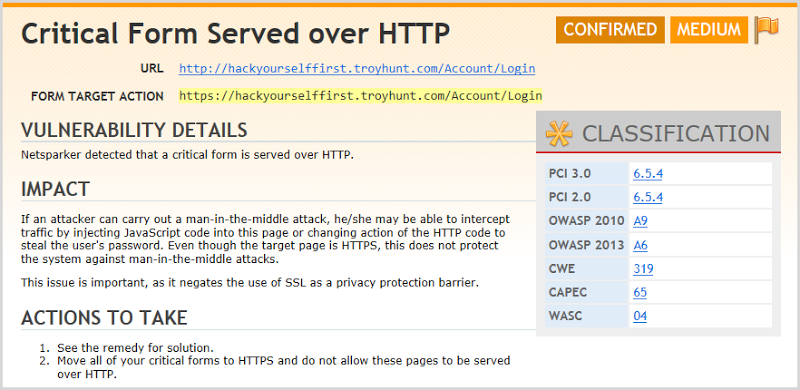
Note the key observation here (and indeed the source of much of my ire): the login form posts to an HTTPS address thus encrypts the credentials under normal operating conditions, but considering it loads the form over an insecure connection you can have no confidence that your data is actually going to be sent to the correct location!
Information technology's the "possible" cantankerous-site scripting findings that are the interesting ones. None of these pose an exploitable run a risk, the first because there is no possibility of reflecting the input in the response (although this resources was the vector for the persistent XSS identified before) and the adjacent two because no resource actually exists that would accept that attack pattern (it's attempting to hit /api/admin/?nsextt=). The latter is a trivial more than interesting in that the error message does reverberate the input parameter, only it'southward correctly encoded for the JSON response in which information technology'southward returned. There shouldn't be an attack vector on any of these, but of course that's why're they've flagged as "possible".
And this is a primal bespeak to make about all tools of this nature – they cannot supervene upon the humans nor can they reliably and consistently get it right without producing any faux positives any. You have to know the system, know the chance and know the assault design in order to draw a conclusion on these. Once more, per the opening para, y'all've gotta take a grip on your app sec to brainstorm with before playing with these tools.
Last matter – how did Netsparker find the "/api/admin" path?! Information technology's not linked in from any public pages, then what gives? Ah, but it is referenced from the robots.txt file and equally I explain in the course, listing paths in this resource can sometimes take an entirely opposite result to desired when the resource is not properly secured. Yes, it'south even so ignored by search engines (if they follow the rules), only it's also an awesome little roadmap to the site for attackers. I'thousand happy to see this one picked upwards.
Low findings
I'one thousand non going to go through all these in detail, merely I will give you a quick snapshot:
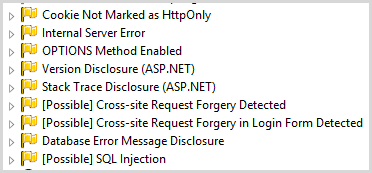
In that location's some adept stuff in hither and it aligns with many of the risks I've deliberately introduced into the app. Things like the auth cookie not being HttpOnly is a good one, although I'yard not convinced that's a low risk whilst a missing secure cookie flag is classified as "important". Stack trace is some other and of course this is a very specific ASP.Net pattern besides so practiced seeing how Netsparker identifies discrete behaviour in popular frameworks. Version disclosure is via noisy response headers and the DB message disclosure is, of form, the very same vector that was used for the error-based SQL injection attack and then possibly a fleck of doubling upwards at that place.
Information findings
This is a bit of a mixed handbag of stuff you may exist very indifferent about (email address disclosure, say on a "contact united states" page) and stuff yous really should exist paying attention to (cross-site scripting protection disabled by way of the X-XSS-Protection response header):
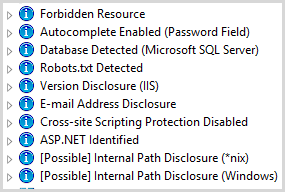
As you lot'd expect from findings with this sort of classification, information technology's the sort of stuff you really need to independently assess and depict your own conclusions from. That's non to say it isn't useful, in fact I remember information technology'south very useful for automating checks of basic stuff that would otherwise be like shooting fish in a barrel nevertheless repetitive and tin can be automated abroad, such as checking for autocomplete on a login form or checking you're disclosing framework versions. Simple stuff, but I'd rather the computers practice the hard work!
Noesis base of operations
One of features that's quite dandy is the Knowledge Base of operations which reports on a bunch of things that could just be informational, or could be used to and then exploit the system:
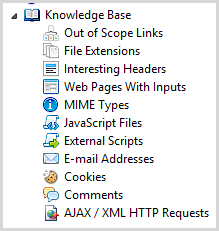
Some of this was actually extremely useful, for example it found the subconscious comment about the database fill-in in the /secret/admin path (don't laugh, I've seen this done):

That path was also pulled from the robots.txt so good use of that guy over again.
It also found a cookie called "Password":
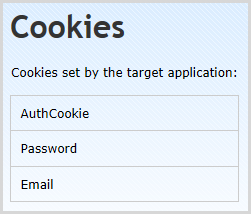
Yes, that's something that should never go in a cookie and yes, people really exercise this. At present of course Netsparker doesn't know that this cookie contains sensitive information that should never be in a cookie to begin with and it would have to make some fairly large assumptions in order to draw that determination. The signal is that this is actually a actually serious take chances and past virtue of surfacing the information in a manner that it can be reviewed, it's more likely to be picked up by someone running through the written report.
Business organisation logic flaws (and how we're all smarter than machines)
One of the really serious vulns in this app is that yous can vote as anyone else by virtue of manipulating the user ID that's sent to the voting API and just substituting information technology with another integer. Netsparker didn't find this and information technology would be a difficult ask for information technology to – it would have to understand the semantic intent of the "userId" parameter and that it could be inverse to another value in such a way that it circumvented a security control. In fact the closest it got to this is list the parameter in the Noesis Base under "AJAX / XML HTTP Requests":
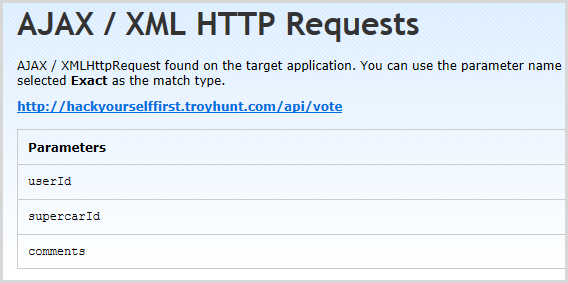
This is actually useful – if I saw this when testing an app the start matter I'd do is go and recreate the request with a dissimilar user ID. Of class I could also easily observe this myself by testing the vote feature anyway but again, having it surfaced this way is more probable to bring information technology to your attention.
Netsparker also wasn't able to place that the business logic which disables the vote push button on a car you've already voted for tin can be circumvented by straight calling that same API from above and simply sending the supercar ID for a vehicle you've already voted on – there'due south no server side control to restrict multiple votes for the aforementioned machine. Aforementioned deal again though in that whilst it'southward a very serious security flaw, it takes human being smarts to pick it upwards.
There's a poignant indicate to be made here about manual assail and penetration tests. Sitting a human down who gains an innate understanding of the business rules and then sets out to break them simply can't be replicated by machines. I poked fun at "security in a box" earlier on and it's for reasons like this that many people scorn automatic tools. Some of them (like Netsparker) are very good, but don't assume for i moment that it's going to find every possible risk in your app because information technology just won't happen. Password storage is some other skilful example – dynamic analysis won't glean that they're sitting there in plain text, in fact even transmission penetration tests won't necessarily discover that (not unless the system is emailing them to you, for example when your forget it), and in a case like that you lot're back to static assay of the code itself. Add together trained humans with access to code and now you're getting somewhere!
What did Netsparker miss?
And now for the one that many of y'all accept inevitably been waiting for – what didn't Netsparker find that it should (or could) have? Last year I invited people to hack me get-go (there was incentive by mode of free Pluralsight passes) and detail what they found in the comments on that web log post. At that place were hundreds of comments and heaps of vulns constitute so that's a adept reference betoken. Allow'due south go through some of them and I'll self-classify the risks into loftier, medium and low. I won't include vulns that definitely require business organisation logic knowledge as yous could never expect those to exist institute in the first place. Also continue in heed that many of these require a number of things to fall into place or certain knowledge to be had that could be very difficult to automate, but it's important to sympathise what aspects of security are not covered above and beyond just those concern logic observations.
High:
- The countersign is sent via e-mail on signup and when using the forgotten password feature. This would be hard to test without registering with a valid email, monitoring the mailbox then inspecting the email contents after signup and reset.
- When changing password, the new and confirm fields are pre-populated with the existing password. A pre-populated countersign field could be detected programmatically.
- Passwords are not stored as cryptographically strong hashes. This can be derived from either of the two previous points and IMHO, is a pretty major observation.
- At that place's no re-authentication required by style of providing the existing password before it's inverse. Information technology might not exist an verbal science to programmatically identify this, but it could be captured equally a "possible" risk.
- The recollect me feature sets a Base64 encoded password in a cookie. Identifying the presence of a remember me feature would unremarkably exist possible by looking for a checkbox at login and comparison the differences in response from normal login versus remembered login would be telling, at least to the point of flagging it equally a "possible" finding.
- There's a mass assignment chance on the "edit profile" page which allows you to send an "IsAdmin" parameter in the Mail asking and drag privileges. You lot could view this every bit the sort of risk that is more business logic or at the very to the lowest degree, difficult to identify via automation. Then once again, the presence of the field is discoverable via other risks (such equally the SQL injection one), but I'm drawing a flake of a long bow past saying the relevance could be implied by whatsoever sort of automated fashion.
- The registration has client side validation on attributes such as password strength but no server side validation. It's a little tricky to automatically identify as you need to be able to parse out the customer script and establish the rules, but if this was possible you could then automate the tests against whether their server side counterparts existed or not.
- At that place's no animal strength protection on the login folio. This one should be easily identified past firing login requests at the page and seeing if the response changes. Of course it could also result in account lockout equally well only that might just exist a test that gets held back to the end of the scan.
Medium:
- The password field has a very "low bar" for both min and max strength (accepts a single char password and maxes out at x chars plus won't allow "special" chars). IMHO this could hands be an automated test, at to the lowest degree the max length attribute on the password field could be.
- The account is locked out as soon as the password reset process is initialised (a new one is sent via e-mail). Once over again, this could exist tested automatically equally a final step in the scan equally once done, the account is no longer attainable unless the email is retrieved and actioned.
Low:
- There'south an business relationship enumeration risk on the reset feature (it tells you whether the email exists or not). At that place'd be a fleck of fuzzy logic required to interpret the response from the organization, just a dissimilar response from a known existing account versus a known non-existing account would be a proficient sign that something is upward. Only then of course in a instance similar this, the reset feature might actually lock the account out so that's another problem to deal with.
- There's no XFO header to prevent clickjacking attacks. This would be dead easy to detect as it's in the response header of each asking. It might simply be a low finding (although I've certainly seen security teams employ information technology as a show-stopper), just it'south useful info that can be reliably detected.
I shared these findings with the Netsparker guys before publishing this postal service (it's the simply thing in this mail service I shared with them for comment earlier publishing) and they've taken it all on board. Some of them are on the cards already and will announced in future releases, others may not due to the reasons I listed in a higher place, namely increased likelihood or simulated positives or bespoke business concern logic that'south difficult to automate.
Transient information states and inconsistent results
Here'southward the matter about websites – they change. Your data land is in one position today which makes certain features visible or invisible so in another state tomorrow and the feature availability changes. For example, in my demo site, if you vote on a vehicle you can no longer vote on that same vehicle again (well actually you can as there'due south a logic vuln, but the "vote" push disappears). If Netsparker is running nether an identity that's voted on every vehicle, it won't see the selection to vote and consequently would never get the opportunity to discover the SQL injection flaw in the vote API.
The bespeak is that you demand to consider what your data state is in before running a browse. As I've said multiple times throughout this post, you really want to recall well-nigh what the right environment to run this scan is in the first place (remember, it may modify your data) and ideally you'd have the ability to restore a examination surroundings to a known data country then that at to the lowest degree the results were consistent over time. Ultimately though, this is one of those "it depends" things – you know the pros and cons by now.
The Netsparker value proposition
I'll spare you the "because getting pwned is expensive" spiel because that understanding is a given. Ok, maybe it's not equally widely understood equally it should be, simply if you're a regular reader hither you lot'll have a bit of a sense of that. Instead, permit's focus on the value proposition of Netsparker in an environment that's already got an awareness of the value of app sec.
The master thing is automation of otherwise laborious tasks; naught that Netsparker does tin can't be washed be humans. The trouble with humans is that they're very expensive for what they do. Checking cookie attributes and output encoding and error configuration is all easy and information technology all takes me a bunch of time to get done. Simply it'due south a repeatable, automatable process and for the same reason I created ASafaWeb to check basic security config settings, Netsparker makes a lot of sense for checking a much, much broader gamut of spider web security risks.
The other surface area where it really makes sense is that you lot can easily put it in the hands of developers who may non be hard cadre security pros. In that location are enough of tools for the latter, but they often don't speak the language of the former. I've seen more confused to-ing and fro-ing between these groups than I've had hot dinners and that's a cost that's rarely captured in the TCO of building software.
Because yous tin can put this in the hands of devs, you tin besides bring those security checks mode forward in the lifecycle of the projection and outset running security assessments very early on on. In fact a few years back I wrote about Continuous web awarding security scanning with Netsparker and TeamCity and that'due south still a very good idea. We've all seen the graphs that prove the cost of fixing cleaved stuff (bugs, optimisations, vulns) exponentially escalating over fourth dimension, correct? Get on pinnacle of the sort of things establish in the study above early and the amount of effort it saves subsequently on can interpret into considerable dollars.
Of class how much it's worth is a very case by example question. On the i hand, yeah, it kicks off at around a couple of grand a year and that sounds like a flake but on the other hand, that's merely about what I spend on coffee. Ok, maybe I'thou drinking too much coffee (although that's simply $five and something a twenty-four hours), but the real value suggestion is in what I don't accept to practise as a issue. For many people, it will also mean the increased confidence they'll accept in their security posture besides and that's something that's hard to put a value on.
Summary
Starting time up, at that place'south a heap of other bits and pieces Netsparker does that I didn't impact, particularly when information technology comes to configuration before the scan. There are likewise other findings I didn't drill down into so go and grab the study I exported if you'd similar to trawl through those yourself.
Next, I hope this makes information technology articulate where the value suggestion of automated scanning tools of all flavours is. They're bully for picking up the stuff that matches known bad patterns and they play a valuable function in doing that, but they don't supervene upon the humans who can mountain attacks against the app logic – those guys are all the same critical.
Finally, I'll finish where I began: you've got to have trained developers who know their app sec. At the end of the day, someone needs to accept these findings and really plug the holes and you lot don't practice that just past making the report look good, y'all do it by agreement the underlying risk, how information technology's exploited, the mitigation patterns in your framework of choice and so really writing secure lawmaking y'all empathise! If this isn't ingrained in developers yet, check out my Pluralsight security courses (and ping me if y'all'd like a free pass). Netsparker is but a nifty companion on that journey.
Oh – one terminal thing – if y'all want an unrestricted trial of Netsparker to run confronting your own domains, hit them on contact@netsparker.com and tell them yous read about information technology hither. Happy scanning!
Source: https://www.troyhunt.com/automating-web-security-reviews-with/
0 Response to "Netsparker Failed to Load Page Try Again"
Post a Comment