What type of energy uses the rays from the sun to produce energy?

The source of Globe's solar ability: the Sunday
Solar free energy is radiant lite and heat from the Sun that is harnessed using a range of technologies such every bit solar power to generate electricity, solar thermal energy including solar water heating, and solar architecture.[1] [2]
Information technology is an essential source of renewable energy, and its technologies are broadly characterized as either passive solar or active solar depending on how they capture and distribute solar free energy or convert it into solar power. Active solar techniques include the use of photovoltaic systems, concentrated solar ability, and solar h2o heating to harness the energy. Passive solar techniques include orienting a edifice to the Sun, selecting materials with favorable thermal mass or light-dispersing properties, and designing spaces that naturally circulate air.
The large magnitude of solar energy available makes information technology a highly appealing source of electricity. Solar energy has been cheaper than fossil fuels since 2021.[iii] [four]
In 2011, the International Energy Agency said that "the development of affordable, inexhaustible and clean solar energy technologies volition have huge longer-term benefits. It volition increment countries' energy security through reliance on an indigenous, inexhaustible, and mostly import-independent resource, enhance sustainability, reduce pollution, lower the costs of mitigating global warming .... These advantages are global.".[ane]
Potential

About half the incoming solar free energy reaches the Globe's surface.

The Earth receives 174 petawatts (PW) of incoming solar radiation (insolation) at the upper atmosphere.[5] Approximately 30% is reflected back to infinite while the residual is absorbed past clouds, oceans and land masses. The spectrum of solar lite at the Earth's surface is mostly spread across the visible and nearly-infrared ranges with a pocket-size part in the near-ultraviolet.[half-dozen] Well-nigh of the world's population live in areas with insolation levels of 150–300 watts/grandii, or 3.5–seven.0 kWh/mtwo per day.[vii]
Solar radiation is absorbed by the Globe's land surface, oceans – which cover well-nigh 71% of the world – and atmosphere. Warm air containing evaporated h2o from the oceans rises, causing atmospheric apportionment or convection. When the air reaches a high altitude, where the temperature is depression, water vapor condenses into clouds, which pelting onto the Earth's surface, completing the water cycle. The latent heat of water condensation amplifies convection, producing atmospheric phenomena such as current of air, cyclones and anticyclones.[8] Sunlight absorbed by the oceans and state masses keeps the surface at an boilerplate temperature of 14 °C.[ix] Past photosynthesis, green plants convert solar energy into chemically stored energy, which produces food, woods and the biomass from which fossil fuels are derived.[10]
The full solar energy absorbed by Earth's atmosphere, oceans and land masses is approximately 3,850,000 exajoules (EJ) per year.[xi] In 2002, this was more energy in one hour than the world used in one twelvemonth.[12] [13] Photosynthesis captures approximately 3,000 EJ per year in biomass.[xiv] The amount of solar free energy reaching the surface of the planet is then vast that in one year it is nigh twice as much as will ever be obtained from all of the Globe's non-renewable resources of coal, oil, natural gas, and mined uranium combined,[15]
| Yearly solar fluxes & human consumption 1 | ||
|---|---|---|
| Solar | three,850,000 | [eleven] |
| Air current | 2,250 | [16] |
| Biomass potential | ~200 | [17] |
| Primary free energy utilise2 | 539 | [eighteen] |
| Electricity2 | ~67 | [19] |
| i Energy given in Exajoule (EJ) = 10eighteen J = 278 TWh 2 Consumption every bit of year 2010 | ||
The potential solar energy that could be used by humans differs from the corporeality of solar energy nowadays near the surface of the planet because factors such as geography, time variation, deject encompass, and the land available to humans limit the corporeality of solar free energy that we can acquire. In 2021, Carbon Tracker Initiative estimated the land area needed to generate all our energy from solar lonely was 450,000 km2- or about the same equally the area of Sweden, or the area of Morocco, or the area of California (0.three% of the Earth's full land area).[20]
Geography affects solar energy potential because areas that are closer to the equator have a higher amount of solar radiations. However, the use of photovoltaics that tin can follow the position of the Sun can significantly increment the solar energy potential in areas that are farther from the equator.[21] Time variation effects the potential of solar energy considering during the nighttime, there is little solar radiations on the surface of the Earth for solar panels to blot. This limits the corporeality of energy that solar panels can absorb in one day. Cloud cover can affect the potential of solar panels because clouds block incoming low-cal from the Sun and reduce the lite available for solar cells.
Likewise, land availability has a large effect on the available solar free energy because solar panels can only be gear up up on land that is otherwise unused and suitable for solar panels. Roofs are a suitable place for solar cells, every bit many people have discovered that they can collect energy straight from their homes this way. Other areas that are suitable for solar cells are lands that are not beingness used for businesses where solar plants can be established.[21]
Solar technologies are characterized as either passive or active depending on the mode they capture, catechumen and distribute sunlight and enable solar energy to be harnessed at different levels around the world, mostly depending on the altitude from the equator. Although solar energy refers primarily to the use of solar radiation for practical ends, all renewable energies, other than Geothermal power and Tidal power, derive their energy either directly or indirectly from the Sun.
Agile solar techniques use photovoltaics, concentrated solar power, solar thermal collectors, pumps, and fans to catechumen sunlight into useful outputs. Passive solar techniques include selecting materials with favorable thermal properties, designing spaces that naturally circulate air, and referencing the position of a building to the Sun. Active solar technologies increment the supply of free energy and are considered supply side technologies, while passive solar technologies reduce the need for alternating resources and are by and large considered demand-side technologies.[22]
In 2000, the United Nations Development Programme, Un Department of Economical and Social Affairs, and World Energy Council published an approximate of the potential solar free energy that could be used by humans each twelvemonth that took into account factors such as insolation, cloud cover, and the land that is usable past humans. The gauge found that solar energy has a global potential of 1,600 to 49,800 exajoules (iv.4×1014 to one.4×ten16 kWh) per year (see tabular array below).[21]
| Region | North America | Latin America and Caribbean area | Western Europe | Central and Eastern Europe | Former Soviet Spousal relationship | Center Eastward and Due north Africa | Sub-Saharan Africa | Pacific Asia | Southern asia | Centrally planned Asia | Pacific OECD |
|---|---|---|---|---|---|---|---|---|---|---|---|
| Minimum | 181.1 | 112.6 | 25.1 | four.v | 199.3 | 412.4 | 371.nine | 41.0 | 38.viii | 115.5 | 72.6 |
| Maximum | vii,410 | 3,385 | 914 | 154 | 8,655 | 11,060 | 9,528 | 994 | 1,339 | 4,135 | 2,263 |
Note:
Quantitative relation of global solar potential vs. the world'southward primary energy consumption:
Source: United Nations Evolution Programme – World Energy Cess (2000)[21] | |||||||||||
Thermal energy
Solar thermal technologies can be used for water heating, space heating, infinite cooling and procedure heat generation.[23]
Early on commercial adaptation
In 1878, at the Universal Exposition in Paris, Augustin Mouchot successfully demonstrated a solar steam engine, but couldn't go along development because of cheap coal and other factors.

1917 Patent drawing of Shuman's solar collector
In 1897, Frank Shuman, a U.s. inventor, engineer and solar energy pioneer congenital a small demonstration solar engine that worked by reflecting solar energy onto foursquare boxes filled with ether, which has a lower boiling signal than water and were fitted internally with black pipes which in turn powered a steam engine. In 1908 Shuman formed the Sun Power Company with the intent of edifice larger solar power plants. He, along with his technical advisor A.S.E. Ackermann and British physicist Sir Charles Vernon Boys,[ citation needed ] developed an improved arrangement using mirrors to reflect solar energy upon collector boxes, increasing heating capacity to the extent that water could at present be used instead of ether. Shuman then synthetic a total-scale steam engine powered by low-pressure h2o, enabling him to patent the unabridged solar engine organisation by 1912.
Shuman congenital the world's first solar thermal power station in Maadi, Egypt, between 1912 and 1913. His plant used parabolic troughs to power a 45–52 kilowatts (threescore–70 hp) engine that pumped more than than 22,000 litres (4,800 imp gal; 5,800 Usa gal) of water per minute from the Nile River to next cotton fields. Although the outbreak of World War I and the discovery of cheap oil in the 1930s discouraged the advancement of solar energy, Shuman'due south vision, and basic design were resurrected in the 1970s with a new moving ridge of interest in solar thermal energy.[24] In 1916 Shuman was quoted in the media advocating solar energy'southward utilization, saying:
Nosotros accept proved the commercial profit of dominicus power in the tropics and take more peculiarly proved that subsequently our stores of oil and coal are exhausted the human race can receive unlimited ability from the rays of the Sun.
—Frank Shuman, New York Times, 2 July 1916[25]
Water heating

Solar h2o heaters facing the Lord's day to maximize gain
Solar hot water systems utilise sunlight to oestrus water. In middle geographical latitudes (betwixt twoscore degrees n and twoscore degrees south), lx to 70% of the domestic hot water use, with water temperatures up to 60 °C (140 °F), tin can be provided by solar heating systems.[26] The nigh common types of solar water heaters are evacuated tube collectors (44%) and glazed flat plate collectors (34%) generally used for domestic hot water; and unglazed plastic collectors (21%) used mainly to heat pond pools.[27]
As of 2015, the total installed capacity of solar hot h2o systems was approximately 436 thermal gigawatt (GWthursday), and China is the world leader in their deployment with 309 GWthursday installed, taken upwardly 71% of the market.[28] Israel and Cyprus are the per capita leaders in the use of solar hot water systems with over 90% of homes using them.[29] In the United States, Canada, and Australia, heating swimming pools is the ascendant application of solar hot water with an installed capacity of xviii GWth as of 2005.[22]
Heating, cooling and ventilation
In the Usa, heating, ventilation and air conditioning (HVAC) systems account for 30% (4.65 EJ/twelvemonth) of the energy used in commercial buildings and well-nigh 50% (ten.1 EJ/yr) of the energy used in residential buildings.[30] [31] Solar heating, cooling and ventilation technologies can be used to outset a portion of this energy. Employ of solar for heating can roughly be divided into passive solar concepts and active solar concepts, depending on whether active elements such as lord's day tracking and solar concentrator eyes are used.

Thermal mass is whatsoever material that can be used to shop oestrus—rut from the Sunday in the case of solar energy. Common thermal mass materials include stone, cement, and water. Historically they have been used in barren climates or warm temperate regions to keep buildings absurd by absorbing solar free energy during the solar day and radiating stored heat to the cooler atmosphere at night. However, they can be used in common cold temperate areas to maintain warmth also. The size and placement of thermal mass depend on several factors such equally climate, daylighting, and shading atmospheric condition. When duly incorporated, thermal mass maintains infinite temperatures in a comfortable range and reduces the need for auxiliary heating and cooling equipment.[32]
A solar chimney (or thermal chimney, in this context) is a passive solar ventilation system equanimous of a vertical shaft connecting the interior and exterior of a building. As the chimney warms, the air within is heated, causing an updraft that pulls air through the building. Performance can be improved by using glazing and thermal mass materials[33] in a manner that mimics greenhouses.
Deciduous trees and plants have been promoted as a ways of controlling solar heating and cooling. When planted on the southern side of a edifice in the northern hemisphere or the northern side in the southern hemisphere, their leaves provide shade during the summer, while the bare limbs permit light to laissez passer during the wintertime.[34] Since bare, leafless trees shade 1/iii to 1/2 of incident solar radiations, there is a balance between the benefits of summer shading and the respective loss of winter heating.[35] In climates with significant heating loads, deciduous trees should not be planted on the Equator-facing side of a building because they will interfere with winter solar availability. They can, nevertheless, be used on the e and west sides to provide a degree of summer shading without appreciably affecting wintertime solar proceeds.[36]
Cooking
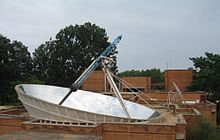
Parabolic dish produces steam for cooking, in Auroville, Bharat
Solar cookers utilize sunlight for cooking, drying, and pasteurization. They can be grouped into three broad categories: box cookers, panel cookers, and reflector cookers.[37] The simplest solar cooker is the box cooker offset congenital past Horace de Saussure in 1767.[38] A basic box cooker consists of an insulated container with a transparent chapeau. It tin can be used effectively with partially clouded skies and will typically reach temperatures of 90–150 °C (194–302 °F).[39] Panel cookers use a cogitating panel to direct sunlight onto an insulated container and reach temperatures comparable to box cookers. Reflector cookers use various concentrating geometries (dish, trough, Fresnel mirrors) to focus low-cal on a cooking container. These cookers reach temperatures of 315 °C (599 °F) and above but require direct low-cal to part properly and must be repositioned to track the Sun.[xl]
Process oestrus
Solar concentrating technologies such every bit parabolic dish, trough and Scheffler reflectors can provide process heat for commercial and industrial applications. The first commercial system was the Solar Total Energy Project (STEP) in Shenandoah, Georgia, US where a field of 114 parabolic dishes provided 50% of the process heating, air conditioning and electrical requirements for a wearable mill. This grid-connected cogeneration organisation provided 400 kW of electricity plus thermal energy in the form of 401 kW steam and 468 kW chilled water, and had a ane-hour peak load thermal storage.[41] Evaporation ponds are shallow pools that concentrate dissolved solids through evaporation. The use of evaporation ponds to obtain table salt from seawater is ane of the oldest applications of solar energy. Modern uses include concentrating brine solutions used in leach mining and removing dissolved solids from waste streams.[42]
Clothes lines, clotheshorses, and clothes racks dry out apparel through evaporation by wind and sunlight without consuming electricity or gas. In some states of the Usa legislation protects the "right to dry" wearing apparel.[43] Unglazed transpired collectors (UTC) are perforated dominicus-facing walls used for preheating ventilation air. UTCs can raise the incoming air temperature upwards to 22 °C (forty °F) and deliver outlet temperatures of 45–sixty °C (113–140 °F).[44] The short payback period of transpired collectors (3 to 12 years) makes them a more than cost-effective alternative than glazed collection systems.[44] Every bit of 2003, over 80 systems with a combined collector area of 35,000 foursquare metres (380,000 sq ft) had been installed worldwide, including an 860 m2 (9,300 sq ft) collector in Costa Rica used for drying coffee beans and a 1,300 m2 (14,000 sq ft) collector in Coimbatore, India, used for drying marigolds.[45] [ needs update ]
Water treatment

Solar distillation can be used to make saline or brackish water drinkable. The kickoff recorded example of this was past 16th-century Arab alchemists.[46] A big-scale solar distillation project was first constructed in 1872 in the Chilean mining boondocks of Las Salinas.[47] The plant, which had solar drove surface area of iv,700 yard2 (51,000 sq ft), could produce up to 22,700 L (5,000 imp gal; 6,000 US gal) per day and operate for 40 years.[47] Individual all the same designs include single-slope, double-slope (or greenhouse type), vertical, conical, inverted cushion, multi-wick, and multiple effect. These stills can operate in passive, active, or hybrid modes. Double-slope stills are the most economical for decentralized domestic purposes, while active multiple effect units are more suitable for large-scale applications.[46]
Solar water disinfection (SODIS) involves exposing h2o-filled plastic polyethylene terephthalate (PET) bottles to sunlight for several hours.[48] Exposure times vary depending on atmospheric condition and climate from a minimum of half dozen hours to two days during fully overcast conditions.[49] It is recommended by the Earth Health System every bit a viable method for household h2o treatment and safe storage.[l] Over ii meg people in developing countries use this method for their daily drinking water.[49]
Solar energy may be used in a h2o stabilization pond to treat waste product water without chemicals or electricity. A farther ecology advantage is that algae grow in such ponds and consume carbon dioxide in photosynthesis, although algae may produce toxic chemicals that make the water unusable.[51] [52]
Molten table salt engineering
Molten salt can exist employed equally a thermal energy storage method to retain thermal energy collected by a solar tower or solar trough of a concentrated solar power plant so that information technology can be used to generate electricity in bad weather or at nighttime. Information technology was demonstrated in the Solar Two project from 1995 to 1999. The organisation is predicted to accept an annual efficiency of 99%, a reference to the energy retained by storing estrus earlier turning it into electricity, versus converting estrus directly into electricity.[53] [54] [55] The molten salt mixtures vary. The most extended mixture contains sodium nitrate, potassium nitrate and calcium nitrate. It is not-flammable and not-toxic, and has already been used in the chemic and metals industries as a estrus-transport fluid. Hence, feel with such systems exists in non-solar applications.
The salt melts at 131 °C (268 °F). It is kept liquid at 288 °C (550 °F) in an insulated "cold" storage tank. The liquid salt is pumped through panels in a solar collector where the focused irradiance heats it to 566 °C (one,051 °F). It is so sent to a hot storage tank. This is and so well insulated that the thermal energy can be usefully stored for up to a week.[56]
When electricity is needed, the hot salt is pumped to a conventional steam-generator to produce superheated steam for a turbine/generator as used in any conventional coal, oil, or nuclear power found. A 100-megawatt turbine would need a tank virtually 9.i metres (30 ft) tall and 24 metres (79 ft) in diameter to bulldoze it for 4 hours by this pattern.
Several parabolic trough ability plants in Spain[57] and solar power tower developer SolarReserve use this thermal energy storage concept. The Solana Generating Station in the U.S. has 6 hours of storage by molten salt. The María Elena establish[58] is a 400 MW thermo-solar complex in the northern Chilean region of Antofagasta employing molten salt engineering.
Electricity production
Solar power is the conversion of renewable energy from sunlight into electricity, either direct using photovoltaics (PV), indirectly using concentrated solar power, or a combination. Photovoltaic cells convert calorie-free into an electric current using the photovoltaic effect.[59] Full-bodied solar power systems utilize lenses or mirrors and solar tracking systems to focus a large area of sunlight to a hot spot, often to drive a steam turbine.
Photovoltaics were initially solely used as a source of electricity for minor and medium-sized applications, from the reckoner powered by a single solar jail cell to remote homes powered by an off-filigree rooftop PV organisation. Commercial concentrated solar power plants were beginning developed in the 1980s. Since then, as the cost of solar electricity has fallen, grid-continued solar PV systems have grown more or less exponentially. Millions of installations and gigawatt-scale photovoltaic power stations have been and are being built. Solar PV has rapidly become an cheap, depression-carbon applied science.
Solar generates 4% of the world'south electricity, compared to one% in 2015 when the Paris Understanding to limit climate change was signed.[60] Along with onshore wind, the cheapest levelised cost of electricity is utility-scale solar.[61] Solar ability in China is over thirty% of generation.[60] The International Free energy Agency said in 2021 that under its "Net Zero by 2050" scenario solar ability would contribute well-nigh 20% of worldwide energy consumption, and solar would be the earth's largest source of electricity.[62]
Photovoltaics


Photovoltaic SUDI shade is an autonomous and mobile station in France that provides energy for electrical cars using solar energy.
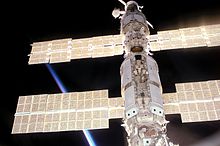
Photovoltaics (PV) is the conversion of lite into electricity using semiconducting materials that exhibit the photovoltaic effect, a phenomenon studied in physics, photochemistry, and electrochemistry. The photovoltaic effect is commercially utilized for electricity generation and as photosensors. The ability organization is controlled using power electronics.
A photovoltaic system employs solar modules, each comprising a number of solar cells, which generate electrical ability. PV installations may be basis-mounted, rooftop-mounted, wall-mounted or floating. The mount may exist fixed or use a solar tracker to follow the sunday across the sky.
Some hope that photovoltaic engineering volition produce plenty affordable sustainable energy to help mitigate global warming acquired past CO2. Solar PV has specific advantages as an energy source: once installed, its operation generates no pollution and no greenhouse gas emissions, it shows uncomplicated scalability in respect of ability needs and silicon has large availability in the Globe'southward crust, although other materials required in PV organization industry such as silver will eventually constrain further growth in the applied science. Other major constraints identified are competition for land utilize and lack of labor in making funding applications.[63] The utilize of PV as a main source requires energy storage systems or global distribution past high-voltage direct electric current ability lines causing additional costs, and besides has a number of other specific disadvantages such as unstable ability generation and the requirement for power companies to compensate for too much solar power in the supply mix by having more reliable conventional ability supplies in guild to regulate demand peaks and potential undersupply. Production and installation does cause pollution and greenhouse gas emissions and in that location are no feasible systems for recycling the panels one time they are at the end of their lifespan afterward 10 to 30 years.
Photovoltaic systems take long been used in specialized applications as stand-alone installations and filigree-connected PV systems have been in use since the 1990s.[64] Photovoltaic modules were first mass-produced in 2000, when German environmentalists and the Eurosolar organisation received government funding for a ten m roof program.[65]
Decreasing costs has allowed PV to grow as an energy source. This has been partially driven by massive Chinese government investment in developing solar production chapters since 2000, and achieving economies of scale. Much of the price of product is from the primal component polysilicon, and most of the world supply is produced in China, especially in Xinjiang. Abreast the subsidies, the low prices of solar panels in the 2010s has been achieved through the low price of energy from coal and cheap labour costs in Xinjiang,[66] equally well every bit improvements in manufacturing technology and efficiency.[67] [68] Advances in engineering and increased manufacturing scale have also increased the efficiency of photovoltaic installations.[64] [69] Net metering and financial incentives, such as preferential feed-in tariffs for solar-generated electricity, accept supported solar PV installations in many countries.[70] Panel prices dropped past a gene of 4 between 2004 and 2011. Module prices dropped 90% of over the 2010s, merely began increasing sharply in 2021.[66] [71]
In 2019, worldwide installed PV capacity increased to more than 635 gigawatts (GW) covering approximately two percentage of global electricity demand.[72] Later hydro and wind powers, PV is the third renewable energy source in terms of global capacity. In 2019 the International Energy Agency expected a growth by 700 - 880 GW from 2019 to 2024.[73] In some instances, PV has offered the cheapest source of electrical ability in regions with a high solar potential, with a bid for pricing every bit low as 0.01567 US$/kWh in Qatar in 2020.[74]
Concentrated solar power
Concentrating Solar Power (CSP) systems employ lenses or mirrors and tracking systems to focus a big area of sunlight into a small beam. The concentrated estrus is then used as a heat source for a conventional power plant. A wide range of concentrating technologies exists; the most developed are the parabolic trough, the solar belfry collectors, the concentrating linear Fresnel reflector, and the Stirling dish. Various techniques are used to rails the Sun and focus light. In all of these systems, a working fluid is heated by the concentrated sunlight, and is so used for power generation or energy storage.[75] Designs demand to account for the risk of a grit storm, hail, or some other extreme weather result that can damage the fine drinking glass surfaces of solar power plants. Metal grills would allow a high percentage of sunlight to enter the mirrors and solar panels while as well preventing near damage.
Architecture and urban planning

Sunlight has influenced edifice design since the beginning of architectural history.[77] Advanced solar architecture and urban planning methods were first employed by the Greeks and Chinese, who oriented their buildings toward the south to provide light and warmth.[78]
The common features of passive solar compages are orientation relative to the Sun, compact proportion (a low surface area to book ratio), selective shading (overhangs) and thermal mass.[77] When these features are tailored to the local climate and surroundings, they tin can produce well-lit spaces that stay in a comfortable temperature range. Socrates' Megaron House is a classic example of passive solar design.[77] The most recent approaches to solar design use figurer modeling tying together solar lighting, heating and ventilation systems in an integrated solar pattern bundle.[79] Active solar equipment such as pumps, fans, and switchable windows tin complement passive design and improve system performance.
Urban rut islands (UHI) are metropolitan areas with higher temperatures than that of the surrounding environment. The higher temperatures result from increased assimilation of solar energy by urban materials such equally cobblestone and concrete, which take lower albedos and college oestrus capacities than those in the natural environment. A straightforward method of counteracting the UHI effect is to paint buildings and roads white and to institute copse in the expanse. Using these methods, a hypothetical "cool communities" program in Los Angeles has projected that urban temperatures could exist reduced by approximately 3 °C at an estimated cost of US$1 billion, giving estimated total annual benefits of US$530 million from reduced ac costs and healthcare savings.[80]
Agriculture and horticulture

Greenhouses similar these in the Westland municipality of the Netherlands grow vegetables, fruits and flowers.
Agronomics and horticulture seek to optimize the capture of solar free energy to optimize the productivity of plants. Techniques such as timed planting cycles, tailored row orientation, staggered heights between rows and the mixing of found varieties can meliorate crop yields.[81] [82] While sunlight is mostly considered a plentiful resource, the exceptions highlight the importance of solar energy to agriculture. During the brusque growing seasons of the Niggling Ice Age, French and English farmers employed fruit walls to maximize the drove of solar free energy. These walls acted as thermal masses and accelerated ripening past keeping plants warm. Early fruit walls were built perpendicular to the footing and facing south, but over time, sloping walls were developed to make improve use of sunlight. In 1699, Nicolas Fatio de Duillier even suggested using a tracking machinery which could pin to follow the Dominicus.[83] Applications of solar energy in agriculture aside from growing crops include pumping water, drying crops, brooding chicks and drying chicken manure.[45] [84] More than recently the technology has been embraced by vintners, who use the energy generated by solar panels to power grape presses.[85]
Greenhouses convert solar light to heat, enabling year-round product and the growth (in enclosed environments) of specialty crops and other plants not naturally suited to the local climate. Archaic greenhouses were showtime used during Roman times to produce cucumbers year-circular for the Roman emperor Tiberius.[86] The first modern greenhouses were built in Europe in the 16th century to go on exotic plants brought back from explorations abroad.[87] Greenhouses remain an of import part of horticulture today. Plastic transparent materials have also been used to similar effect in polytunnels and row covers.
Transport


Development of a solar-powered car has been an engineering goal since the 1980s. The Globe Solar Claiming is a biannual solar-powered car race, where teams from universities and enterprises compete over 3,021 kilometres (1,877 mi) across central Australia from Darwin to Adelaide. In 1987, when it was founded, the winner'south boilerplate speed was 67 kilometres per hour (42 mph) and by 2007 the winner'due south average speed had improved to 90.87 kilometres per hour (56.46 mph).[88] The N American Solar Challenge and the planned South African Solar Challenge are comparable competitions that reflect an international interest in the engineering science and development of solar powered vehicles.[89] [90]
Some vehicles utilise solar panels for auxiliary power, such as for air conditioning, to go on the interior cool, thus reducing fuel consumption.[91] [92]
In 1975, the outset practical solar boat was constructed in England.[93] By 1995, passenger boats incorporating PV panels began appearing and are now used extensively.[94] In 1996, Kenichi Horie fabricated the first solar-powered crossing of the Pacific Sea, and the Sun21 catamaran fabricated the offset solar-powered crossing of the Atlantic Ocean in the wintertime of 2006–2007.[95] There were plans to circumnavigate the globe in 2010.[96]
In 1974, the unmanned AstroFlight Sunrise airplane made the first solar flight. On 29 April 1979, the Solar Riser made the first flight in a solar-powered, fully controlled, man-conveying flying machine, reaching an altitude of 40 ft (12 1000). In 1980, the Gossamer Penguin made the first piloted flights powered solely by photovoltaics. This was apace followed by the Solar Challenger which crossed the English language Aqueduct in July 1981. In 1990 Eric Scott Raymond in 21 hops flew from California to North Carolina using solar power.[97] Developments and then turned dorsum to unmanned aerial vehicles (UAV) with the Pathfinder (1997) and subsequent designs, culminating in the Helios which set the altitude record for a non-rocket-propelled aircraft at 29,524 metres (96,864 ft) in 2001.[98] The Zephyr, developed by BAE Systems, is the latest in a line of tape-breaking solar shipping, making a 54-hour flight in 2007, and month-long flights were envisioned by 2010.[99] As of 2016, Solar Impulse, an electric shipping, is currently circumnavigating the world. It is a unmarried-seat plane powered by solar cells and capable of taking off nether its ain power. The design allows the aircraft to remain airborne for several days.[100]
A solar airship is a black balloon that is filled with ordinary air. As sunlight shines on the airship, the air inside is heated and expands, causing an up buoyancy strength, much similar an artificially heated hot air balloon. Some solar balloons are large enough for man flight, just usage is generally express to the toy market as the surface-area to payload-weight ratio is relatively high.[101]
Fuel production
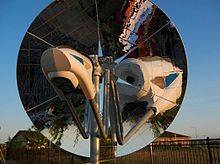
Full-bodied solar panels are getting a ability boost. Pacific Northwest National Laboratory (PNNL) volition exist testing a new concentrated solar power arrangement – one that can assist natural gas ability plants reduce their fuel usage by upwards to 20 percent.[ needs update ]
Solar chemical processes utilize solar energy to drive chemical reactions. These processes offset energy that would otherwise come from a fossil fuel source and can also convert solar energy into storable and transportable fuels. Solar induced chemical reactions tin exist divided into thermochemical or photochemical.[102] A variety of fuels can exist produced by artificial photosynthesis.[103] The multielectron catalytic chemical science involved in making carbon-based fuels (such as methanol) from reduction of carbon dioxide is challenging; a feasible alternative is hydrogen product from protons, though use of water as the source of electrons (every bit plants practice) requires mastering the multielectron oxidation of two water molecules to molecular oxygen.[104] Some accept envisaged working solar fuel plants in coastal metropolitan areas by 2050 – the splitting of seawater providing hydrogen to exist run through adjacent fuel-cell electric power plants and the pure water by-product going directly into the municipal water system.[105]
Hydrogen production technologies take been a significant area of solar chemical research since the 1970s. Aside from electrolysis driven past photovoltaic or photochemical cells, several thermochemical processes have also been explored. 1 such route uses concentrators to dissever water into oxygen and hydrogen at high temperatures (2,300–two,600 °C or four,200–four,700 °F).[106] Some other arroyo uses the estrus from solar concentrators to bulldoze the steam reformation of natural gas thereby increasing the overall hydrogen yield compared to conventional reforming methods.[107] Thermochemical cycles characterized by the decomposition and regeneration of reactants present another avenue for hydrogen production. The Solzinc process under development at the Weizmann Institute of Scientific discipline uses a ane MW solar furnace to decompose zinc oxide (ZnO) at temperatures to a higher place 1,200 °C (2,200 °F). This initial reaction produces pure zinc, which tin can afterwards exist reacted with water to produce hydrogen.[108]
Energy storage methods

Thermal mass systems tin store solar energy in the form of heat at domestically useful temperatures for daily or interseasonal durations. Thermal storage systems generally employ readily available materials with loftier specific rut capacities such as water, earth and stone. Well-designed systems can lower peak demand, shift time-of-utilise to off-top hours and reduce overall heating and cooling requirements.[109] [110]
Stage change materials such as alkane series wax and Glauber's common salt are another thermal storage medium. These materials are inexpensive, readily bachelor, and can deliver domestically useful temperatures (approximately 64 °C or 147 °F). The "Dover House" (in Dover, Massachusetts) was the first to use a Glauber's salt heating system, in 1948.[111] Solar energy tin as well be stored at high temperatures using molten salts. Salts are an effective storage medium because they are low-cost, have a loftier specific estrus capacity, and can deliver rut at temperatures uniform with conventional power systems. The Solar Ii projection used this method of energy storage, allowing it to store ane.44 terajoules (400,000 kWh) in its 68 m³ storage tank with an annual storage efficiency of well-nigh 99%.[112]
Off-grid PV systems have traditionally used rechargeable batteries to store backlog electricity. With grid-tied systems, excess electricity tin can be sent to the transmission filigree, while standard grid electricity can be used to meet shortfalls. Internet metering programs give household systems credit for any electricity they deliver to the grid. This is handled by 'rolling back' the meter whenever the home produces more electricity than it consumes. If the cyberspace electricity utilize is below zero, the utility then rolls over the kilowatt-hour credit to the next month.[113] Other approaches involve the use of ii meters, to mensurate electricity consumed vs. electricity produced. This is less common due to the increased installation cost of the second meter. Most standard meters accurately mensurate in both directions, making a 2d meter unnecessary.
Pumped-storage hydroelectricity stores energy in the grade of water pumped when energy is available from a lower elevation reservoir to a higher superlative i. The energy is recovered when need is high by releasing the water, with the pump becoming a hydroelectric ability generator.[114]
Development, deployment and economics


Toll evolution of solar PV modules per watt
Beginning with the surge in coal use, which accompanied the Industrial Revolution, free energy consumption has steadily transitioned from woods and biomass to fossil fuels. The early on development of solar technologies starting in the 1860s was driven by an expectation that coal would soon become scarce. However, development of solar technologies stagnated in the early 20th century in the face of the increasing availability, economy, and utility of coal and petroleum.[115]
The 1973 oil embargo and 1979 energy crunch acquired a reorganization of energy policies around the globe. It brought renewed attention to developing solar technologies.[116] [117] Deployment strategies focused on incentive programs such as the Federal Photovoltaic Utilization Plan in the US and the Sunshine Program in Japan. Other efforts included the germination of research facilities in the U.s. (SERI, now NREL), Japan (NEDO), and Germany (Fraunhofer Institute for Solar Energy Systems ISE).[118]
Commercial solar h2o heaters began appearing in the United states of america in the 1890s.[119] These systems saw increasing utilise until the 1920s but were gradually replaced by cheaper and more reliable heating fuels.[120] As with photovoltaics, solar water heating attracted renewed attention as a event of the oil crises in the 1970s, but interest subsided in the 1980s due to falling petroleum prices. Development in the solar water heating sector progressed steadily throughout the 1990s, and annual growth rates have averaged 20% since 1999.[121] Although more often than not underestimated, solar water heating and cooling is by far the most widely deployed solar engineering with an estimated capacity of 154 GW as of 2007.[121]
The International Energy Agency has said that solar free energy tin can make considerable contributions to solving some of the most urgent problems the world now faces:[1]
The development of affordable, inexhaustible, and clean solar energy technologies volition accept huge longer-term benefits. It will increment countries' free energy security through reliance on an indigenous, inexhaustible, and mostly import-independent resources, enhance sustainability, reduce pollution, lower the costs of mitigating climate change, and go on fossil fuel prices lower than otherwise. These advantages are global. Hence the additional costs of the incentives for early on deployment should be considered learning investments; they must be wisely spent and demand to be widely shared.[1]
In 2011, a report by the International Energy Agency constitute that solar free energy technologies such every bit photovoltaics, solar hot water, and concentrated solar power could provide a 3rd of the earth'southward free energy past 2060 if politicians commit to limiting climate alter and transitioning to renewable energy. The free energy from the Dominicus could play a fundamental role in de-carbonizing the global economic system alongside improvements in energy efficiency and imposing costs on greenhouse gas emitters. "The forcefulness of solar is the incredible variety and flexibility of applications, from pocket-sized scale to big scale".[122]
We have proved ... that subsequently our stores of oil and coal are exhausted the human race can receive unlimited power from the rays of the Sunday.
In 2021 Lazard estimated the levelized cost of new build unsubsidized utility scale solar electricity at less than 37 dollars[ clarification needed ] and existing coal-fired power above that amount.[123] [124] The 2021 report besides said that new solar was besides cheaper than new gas-fired power, but not generally existing gas power.[124]
ISO standards
The International System for Standardization has established several standards relating to solar energy equipment. For case, ISO 9050 relates to glass in the building, while ISO 10217 relates to the materials used in solar h2o heaters.
See too
- Heliostat
- List of solar free energy topics
- Renewable rut
- Soil solarization
- Solar easement
- Solar energy utilisation in rural Africa
- Solar updraft tower
- Solar power satellite
- Solar tracker
References
- ^ a b c d "Solar Energy Perspectives: Executive Summary" (PDF). International Free energy Agency. 2011. Archived from the original (PDF) on 13 January 2012.
- ^ "Energy". rsc.org. 2 April 2014.
- ^ "'Renewables' power alee to become the earth's cheapest source of free energy in 2020". World Economic Forum . Retrieved 2022-01-25 .
- ^ "Levelized Cost Of Energy, Levelized Price Of Storage, and Levelized Cost Of Hydrogen". Lazard.com . Retrieved 2022-01-25 .
- ^ Smil (1991), p. 240
- ^ "Natural Forcing of the Climate System". Intergovernmental Panel on Climate Change. Archived from the original on 29 September 2007. Retrieved 29 September 2007.
- ^ Karuppu, Karthik; Sitaraman, Venk; NVICO (2019). Solar Assessment Guidance: A Guide for Solar Trainee, Trainer & Assessor Examination. Notion Press. ISBN978-1646505227.
- ^ "Radiation Budget". NASA Langley Inquiry Center. 17 Oct 2006. Retrieved 29 September 2007.
- ^ Somerville, Richard. "Historical Overview of Climatic change Science" (PDF). Intergovernmental Panel on Climate Alter. Retrieved 29 September 2007.
- ^ Vermass, Wim. "An Introduction to Photosynthesis and Its Applications". Arizona State University. Archived from the original on 3 December 1998. Retrieved 29 September 2007.
- ^ a b Smil (2006), p. 12
- ^ Morton, Oliver (6 September 2006). "Solar energy: A new solar day dawning?: Silicon Valley sunrise". Nature. 443 (7107): nineteen–22. Bibcode:2006Natur.443...19M. doi:ten.1038/443019a. PMID 16957705. S2CID 13266273.
- ^ Lewis, North. S.; Nocera, D. K. (2006). "Powering the Planet: Chemical challenges in solar free energy utilization" (PDF). Proceedings of the National Academy of Sciences. 103 (43): 15729–35. Bibcode:2006PNAS..10315729L. doi:10.1073/pnas.0603395103. PMC1635072. PMID 17043226. Retrieved 7 Baronial 2008.
- ^ "Energy conversion by photosynthetic organisms". Food and Agriculture Organization of the Un. Retrieved 25 May 2008.
- ^ "Exergy Catamenia Charts – GCEP". stanford.edu.
- ^ Archer, Cristina; Jacobson, Mark. "Evaluation of Global Wind Ability". Stanford. Retrieved iii June 2008.
- ^ "Renewable Energy Sources" (PDF). Renewable and Appropriate Free energy Laboratory. p. 12. Archived from the original (PDF) on 19 November 2012. Retrieved half-dozen Dec 2012.
- ^ "Full Primary Free energy Consumption". Free energy Information Administration. Retrieved thirty June 2013.
- ^ "Full Electricity Net Consumption". Energy Information Administration. Retrieved 30 June 2013.
- ^ Bail, Kingsmill (Apr 2021). "The sky'south the limit" (PDF). epbr. Carbon Tracker Initiative. p. 6. Archived (PDF) from the original on April 30, 2021. Retrieved October 22, 2021.
- ^ a b c d e "Energy and the claiming of sustainability" (PDF). United Nations Development Program and Globe Energy Council. September 2000. Retrieved 17 January 2017.
- ^ a b Philibert, Cédric (2005). "The Present and Future use of Solar Thermal Energy as a Primary Source of Energy" (PDF). IEA. Archived (PDF) from the original on 26 Apr 2012.
- ^ "Solar Energy Technologies and Applications". Canadian Renewable Free energy Network. Archived from the original on 25 June 2002. Retrieved 22 Oct 2007.
- ^ Smith, Zachary Alden; Taylor, Katrina D. (2008). Renewable And Alternative Energy Resources: A Reference Handbook . ABC-CLIO. p. 174. ISBN978-one-59884-089-half dozen.
- ^ a b "American Inventor Uses Arab republic of egypt'due south Sun for Power – Appliance Concentrates the Heat Rays and Produces Steam, Which Tin Exist Used to Drive Irrigation Pumps in Hot Climates" (PDF). nytimes.com. 2 July 1916.
- ^ "Renewables for Heating and Cooling" (PDF). International Energy Agency. Retrieved 13 August 2015.
- ^ Weiss, Werner; Bergmann, Irene; Faninger, Gerhard. "Solar Rut Worldwide (Markets and Contributions to the Free energy Supply 2005)" (PDF). International Energy Agency. Retrieved 30 May 2008.
- ^ "Solar District Heating In The People's Commonwealth of People's republic of china" (PDF). Status and Development Potential. Asian Evolution Bank: 23. 1 July 2019. Retrieved 6 July 2021.
- ^ Del Chiaro, Bernadette; Telleen-Lawton, Timothy. "Solar Water Heating (How California Can Reduce Its Dependence on Natural Gas)" (PDF). Surround California Enquiry and Policy Center. Archived from the original (PDF) on 27 September 2007. Retrieved 29 September 2007.
- ^ Apte, J.; et al. "Time to come Advanced Windows for Nada-Energy Homes" (PDF). American Lodge of Heating, Refrigerating and Air-Workout Engineers. Archived from the original (PDF) on 10 April 2008. Retrieved 9 April 2008.
- ^ "Energy Consumption Characteristics of Commercial Building HVAC Systems Volume Three: Energy Savings Potential" (PDF). United States Section of Energy. Retrieved 24 June 2008.
- ^ Mazria (1979), pp. 29–35
- ^ Brilliant, David (18 February 1977). "Passive solar heating simpler for the average possessor". Bangor Daily News . Retrieved 3 July 2011.
- ^ Mazria (1979), p. 255
- ^ Balcomb (1992), p. 56
- ^ Balcomb (1992), p. 57
- ^ Anderson and Palkovic (1994), p. xi
- ^ Butti and Perlin (1981), pp. 54–59
- ^ , Anderson and Palkovic (1994), p. xii
- ^ Anderson and Palkovic (1994), p. xiii
- ^ Stine, Due west.B. & Harrigan, R.W. (1982). "Shenandoah Solar Total Energy Project". NASA Sti/Recon Technical Report Due north. John Wiley. 83: 25168. Bibcode:1982STIN...8325168L. Retrieved 20 July 2008.
- ^ Bartlett (1998), pp. 393–94
- ^ Thomson-Philbrook, Julia. "Right to Dry Legislation in New England and Other States". Connecticut General Assembly. Retrieved 27 May 2008.
- ^ a b "Solar Buildings (Transpired Air Collectors – Ventilation Preheating)" (PDF). National Renewable Energy Laboratory. Retrieved 29 September 2007.
- ^ a b Leon (2006), p. 62
- ^ a b Tiwari (2003), pp. 368–71
- ^ a b Daniels (1964), p. 6
- ^ "SODIS solar water disinfection". EAWAG (The Swiss Federal Institute for Environmental Science and Engineering). Retrieved 2 May 2008.
- ^ a b "Household H2o Handling Options in Developing Countries: Solar Disinfection (SODIS)" (PDF). Centers for Disease Control and Prevention. Archived from the original (PDF) on 29 May 2008. Retrieved 13 May 2008.
- ^ "Household Water Treatment and Safe Storage". Globe Wellness Organization. Archived from the original on October 25, 2004. Retrieved 2 May 2008.
- ^ Shilton A.N.; Powell Due north.; Mara D.D.; Craggs R. (2008). "Solar-powered aeration and disinfection, anaerobic co-digestion, biological CO(2) scrubbing and biofuel production: the energy and carbon direction opportunities of waste stabilization ponds". Water Sci. Technol. 58 (1): 253–58. doi:10.2166/wst.2008.666. PMID 18653962.
- ^ Tadesse I.; Isoaho S.A.; Green F.B.; Puhakka J.A. (2003). "Removal of organics and nutrients from tannery effluent by avant-garde integrated Wastewater Pond Systems technology". Water Sci. Technol. 48 (2): 307–14. doi:x.2166/wst.2003.0135. PMID 14510225.
- ^ Mancini, Tom (10 January 2006). "Advantages of Using Molten Salt". Sandia National Laboratories. Archived from the original on 5 June 2011. Retrieved 14 July 2011.
- ^ Molten salt free energy storage system – A feasibility written report Jones, B.G.; Roy, R.P.; Bohl, R.W. (1977) – Smithsonian/NASA ADS Physics Abstract Service. Abstruse accessed Dec 2007
- ^ Biello, David. "How to Use Solar Free energy at Night". Scientific American . Retrieved xix June 2011.
- ^ Ehrlich, Robert, 2013, "Renewable Energy: A Offset Form," CRC Press, Chap. xiii.1.22 Thermal storage p. 375 ISBN 978-1-4398-6115-8
- ^ Parabolic Trough Thermal Energy Storage Engineering Archived 1 September 2013 at the Wayback Machine Parabolic Trough Solar Power Network. 4 April 2007. Accessed December 2007
- ^ Here comes the sun Republic of chile greenlights enormous 400-megawatt solar project world wide web.thisischile.cl Friday, 23 August 2013 retrieved 30 Baronial 2013
- ^ "Free energy Sources: Solar". Department of Free energy. Archived from the original on xiv April 2011. Retrieved nineteen April 2011.
- ^ a b "Global Electricity Review 2022". Ember. 2022-03-29. Retrieved 2022-04-03 .
- ^ "Levelized Cost Of Energy, Levelized Cost Of Storage, and Levelized Cost Of Hydrogen". Lazard.com . Retrieved 2022-04-03 .
- ^ "Net Zero past 2050 – Analysis". IEA . Retrieved 2021-ten-14 .
- ^ Lo Piano, Samuele; Mayumi, Kozo (2017). "Toward an integrated assessment of the operation of photovoltaic systems for electricity generation". Applied Free energy. 186 (ii): 167–74. doi:10.1016/j.apenergy.2016.05.102.
- ^ a b Bazilian, One thousand.; Onyeji, I.; Liebreich, M.; MacGill, I.; Chase, J.; Shah, J.; Gielen, D.; Arent, D.; Landfear, D.; Zhengrong, S. (2013). "Re-because the economics of photovoltaic power" (PDF). Renewable Energy. 53: 329–338. CiteSeerX10.one.1.692.1880. doi:10.1016/j.renene.2012.11.029. Archived from the original (PDF) on 31 August 2014. Retrieved four September 2015.
- ^ Palz, Wolfgang (2013). Solar Power for the Earth: What Y'all Wanted to Know about Photovoltaics. CRC Printing. pp. 131–. ISBN978-981-4411-87-5.
- ^ a b "Biden's New Problem: Rising Solar Console Prices". Found for Energy Research. 2 June 2021. Retrieved viii June 2021.
- ^ "Why did renewables go so cheap so fast?". Our World in Information. Dec one, 2020.
- ^ Shubbak, Mahmood H. (2019). "The technological system of product and innovation: The case of photovoltaic engineering science in China". Enquiry Policy. 48 (4): 993–1015. doi:x.1016/j.respol.2018.x.003. S2CID 158742469.
- ^ Swanson, R. 1000. (2009). "Photovoltaics Power Up" (PDF). Science. 324 (5929): 891–2. doi:x.1126/science.1169616. PMID 19443773. S2CID 37524007.
- ^ Renewable Energy Policy Network for the 21st century (REN21), Renewables 2010 Global Condition Report, Paris, 2010, pp. 1–80.
- ^ Xiao, Carrie (7 June 2021). "Tackling solar'south polysilicon crisis, part one: Supply chain flexibility, differentiation and rigorous testing". PV Tech Premium . Retrieved viii June 2021.
- ^ "PHOTOVOLTAICS REPORT" (PDF). Fraunhofer Plant for Solar Free energy Systems. 16 September 2020. p. four.
- ^ "Renewables 2019". IEA. Retrieved 26 January 2020.
- ^ "KAHRAMAA and Siraj Energy Sign Agreements for Al-Kharsaah Solar PV Power Constitute". Qatar General Electricity & Water Corporation "KAHRAMAA". 20 January 2020. Retrieved 26 January 2020.
- ^ Martin and Goswami (2005), p. 45
- ^ "Darmstadt University of Applied science solar decathlon home design". Darmstadt University of Technology. Archived from the original on 18 October 2007. Retrieved 25 Apr 2008.
- ^ a b c Schittich (2003), p. fourteen
- ^ Butti and Perlin (1981), pp. 4, 159
- ^ Balcomb (1992)
- ^ Rosenfeld, Arthur; et al. "Painting the Town White – and Dark-green". Heat Island Grouping. Archived from the original on 14 July 2007. Retrieved 29 September 2007.
- ^ Jeffrey C. Silvertooth. "Row Spacing, Found Population, and Yield Relationships". University of Arizona. Retrieved 24 June 2008.
- ^ Kaul (2005), pp. 169–74
- ^ Butti and Perlin (1981), pp. 42–46
- ^ Bénard (1981), p. 347
- ^ "A Powerhouse Winery". News Update. Novus Vinum. 27 October 2008. Retrieved 5 November 2008.
- ^ Butti and Perlin (1981), p. nineteen
- ^ Butti and Perlin (1981), p. 41
- ^ "The Globe Solar Challenge – The Groundwork" (PDF). Australian and New Zealand Solar Energy Society. Archived from the original (PDF) on nineteen July 2008. Retrieved 5 August 2008.
- ^ "North American Solar Claiming". New Resources Group. Retrieved 3 July 2008.
- ^ "Southward African Solar Claiming". Advanced Energy Foundation. Archived from the original on 12 June 2008. Retrieved 3 July 2008.
- ^ Vehicle auxiliary power applications for solar cells. 1991. pp. 187–191. ISBN0-85296-525-7 . Retrieved 11 October 2008.
- ^ "Archived re-create". Archived from the original on 5 May 2009. Retrieved 29 March 2011.
{{cite spider web}}: CS1 maint: archived copy as championship (link) - ^ Electrical Review Vol. 201, No. vii, 12 Baronial 1977
- ^ Schmidt, Theodor. "Solar Ships for the new Millennium". TO Engineering. Archived from the original on nine October 2007. Retrieved 30 September 2007.
- ^ "The sun21 completes the kickoff transatlantic crossing with a solar powered gunkhole". Transatlantic 21. Retrieved 30 September 2007.
- ^ "PlanetSolar, the first solar-powered round-the-world voyage". PlanetSolar. 14 August 2015. Retrieved twenty November 2016.
- ^ "Archived copy". Archived from the original on 8 February 2008. Retrieved 8 Feb 2008.
{{cite spider web}}: CS1 maint: archived copy as title (link) - ^ "Solar-Power Research and Dryden". NASA. Retrieved 30 April 2008.
- ^ "The NASA ERAST Unhurt UAV Programme". Greg Goebel. Archived from the original on 10 February 2008. Retrieved xxx April 2008.
- ^ Solar Impulse Project. "HB-SIA Mission". Archived from the original on 26 July 2011. Retrieved 5 December 2009.
- ^ "Phenomena which affect a solar balloon". pagesperso-orange.fr. Retrieved 19 August 2008.
- ^ Bolton (1977), p. 1
- ^ Wasielewski MR Photoinduced electron transfer in supramolecular systems for bogus photosynthesis. Chem. Rev. 1992; 92: 435–61.
- ^ Hammarstrom 50. and Hammes-Schiffer S. Artificial Photosynthesis and Solar Fuels. Accounts of Chemical Research 2009; 42 (12): 1859–60.
- ^ Gray H.B. Powering the planet with solar fuel. Nature Chemistry 2009; 1: 7.
- ^ Agrafiotis (2005), p. 409
- ^ Zedtwitz (2006), p. 1333
- ^ "Solar Energy Project at the Weizmann Institute Promises to Advance the use of Hydrogen Fuel". Weizmann Plant of Science. Archived from the original on half dozen April 2008. Retrieved 25 June 2008.
- ^ Balcomb(1992), p. 6
- ^ "Request for Participation Summer 2005 Demand Shifting with Thermal Mass" (PDF). Need Response Research Middle. Archived from the original (PDF) on 7 September 2008. Retrieved 26 November 2007.
- ^ Butti and Perlin (1981), pp. 212–xiv
- ^ "Advantages of Using Molten Salt". Sandia National Laboratory. Retrieved 29 September 2007.
- ^ "PV Systems and Net Metering". Section of Energy. Archived from the original on four July 2008. Retrieved 31 July 2008.
- ^ "Pumped Hydro Storage". Electricity Storage Association. Archived from the original on 21 June 2008. Retrieved 31 July 2008.
- ^ Butti and Perlin (1981), pp. 63, 77, 101
- ^ Butti and Perlin (1981), p. 249
- ^ Yergin (1991), pp. 634, 653–73
- ^ "Relate of Fraunhofer-Gesellschaft". Fraunhofer-Gesellschaft. Retrieved 4 November 2007.
- ^ Butti, and Perlin (1981), p. 117
- ^ Butti and Perlin (1981), p. 139
- ^ a b Weiss, Werner; Bergmann, Irene; Faninger, Gerhard. "Solar Oestrus Worldwide – Markets and Contribution to the Energy Supply 2006" (PDF). International Energy Bureau. Retrieved 9 June 2008.
- ^ "IEA Says Solar May Provide a 3rd of Global Energy by 2060". Bloomberg Businessweek. 1 December 2011.
- ^ "'Renewables' ability ahead to go the world's cheapest source of free energy in 2020". World Economic Forum . Retrieved 2022-01-25 .
- ^ a b "Levelized Cost Of Free energy, Levelized Cost Of Storage, and Levelized Price Of Hydrogen". Lazard.com . Retrieved 2022-01-25 .
Further reading
- Denzer, Anthony (2013). The Solar House: Pioneering Sustainable Blueprint. Rizzoli. ISBN978-0-8478-4005-2. Archived from the original on 26 July 2013.
Source: https://en.wikipedia.org/wiki/Solar_energy
0 Response to "What type of energy uses the rays from the sun to produce energy?"
Post a Comment